The Journal / Beliefs
When rituals rhyme with reason
Proverbs, offerings and biodynamics: when rites complement reason.
In today’s vineyards, science reduces uncertainty, but it does not explain everything.
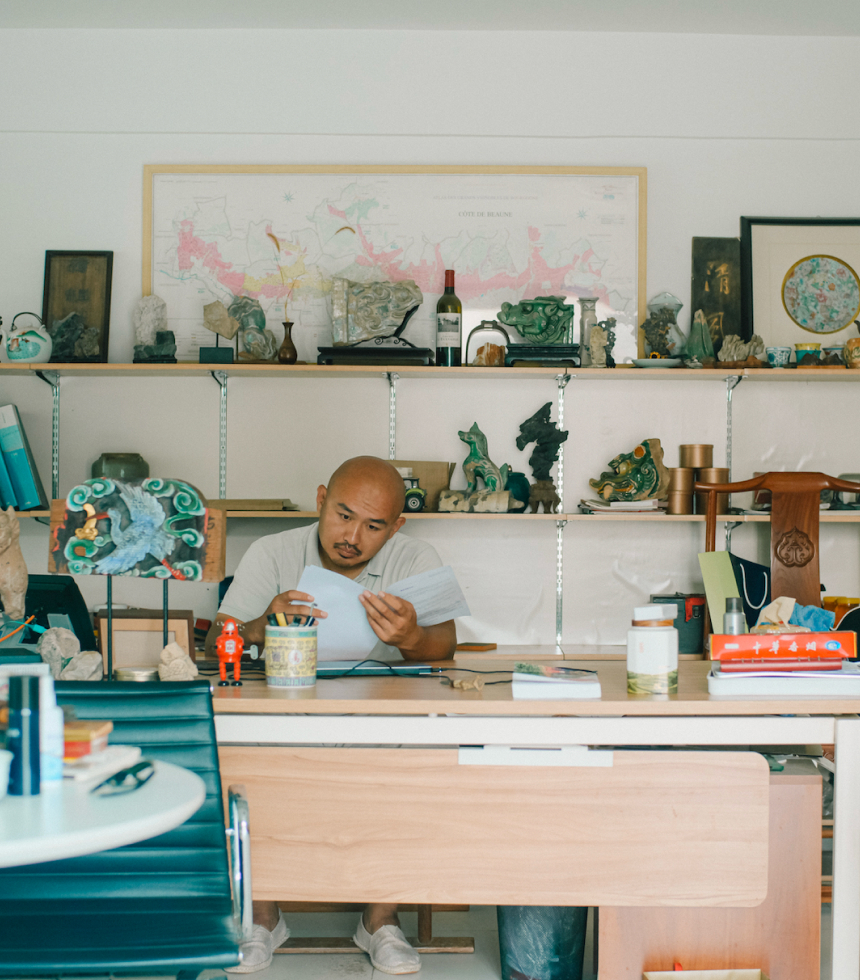
Proverbs, offerings and biodynamics: when rites complement reason.
In today’s vineyards, science reduces uncertainty, but it does not explain everything.
In today’s vineyards, science reduces uncertainty, but it does not explain everything. From the Paulée at Domaine William Fèvre in Chablis to the improvised altars of Domaine de Long Dai, from the saints of Mendoza to the biodynamic preparations studied by Manuela de Lachapelle, discover rites that have endured, faded away and made a comeback.
France: a catalogue of surviving rituals
In French vineyards, rituals have become a rarity. François Ménin, Vineyard Manager at William Fèvre in Chablis, recalls the Burgundian wisdom of his wife’s grandmother, a retired winegrower: ‘By Pentecost, the vines should stretch from slope to slope.’ A sign of vigour at the right moment. ‘By St Catherine’s Day, everything takes root,’ a reminder that November is the time to plant.
These sayings once structured the seasons and the work that accompanied them. They are still quoted, though followed less often. Vines are now monitored by sensors, the weather by radar, the cellar by probes. The gestures remain, but they are usually justified by science. A handful of rites persist nonetheless, lying quietly beneath the surface of rational practice.
At William Fèvre in Chablis, the vintage still ends with the Paulée. Gathered in the harvest hall, the team uncorks bottles from past years that mirror the conditions of the one just completed. In a hot year, for instance, a 2003 might be opened as a reminder that harvesting early helps preserve acidity.
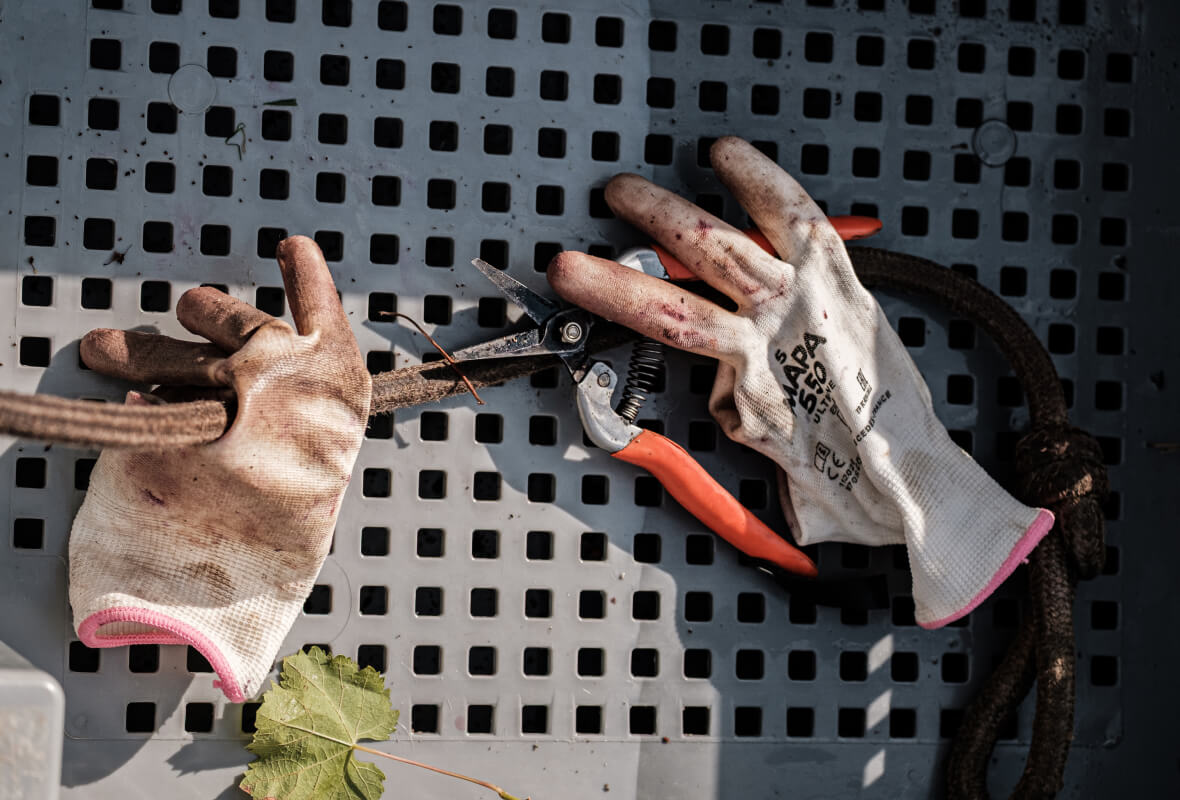
Tools, too, carry their share of ritual. In all our estates, pruning shears are treated almost as talismans. Each grower has their own pair, adjusted to the hand and marked with a name. They are never lent. Folklore survives in the cooperage as well. There is the barrel said to hold ‘226 litres’, one more than the standard, so workers can sneak a taste using a Bic pen as an improvised pipette. A joke or a rite? Our piece on fact and folklore invites you to decide.
At Château L’Évangile, rituals take the form of friendly competitions. The first person to photograph a vine flower wins a bottle. Guessing the total harvest tonnage earns another. A playful way of sharing knowledge about the vineyard parcels.
Other rituals slowly fade away. Olivier Bonneau, Estate Manager of Château Duhart-Milon and Château Lafite Rothschild, recalls how a candle or lighter was once lowered into a vat. If the flame went out, carbon dioxide was present, so no one would enter to remove the grape marc. Today, precise sensors have replaced the flame. Even so, Olivier still lights his lighter from time to time.
China and Latin America: where the vine still follows its rites
Ten thousand kilometres away, at Domaine de Long Dai in China, rituals remain very much alive.
‘The lunar calendar is fundamental in Chinese culture. Its key dates are all linked to the climate,’ explains Pierre-Antoine Richez, Deputy Technical Director for the DBR Lafite group, after three years working at the estate.
So when climatic pressure rises as summer approaches, improvised altars sometimes appear between the rows. Jewellery, bowls of rice, packets of cigarettes: small offerings that speak of the growers’ attachment to the vineyard.
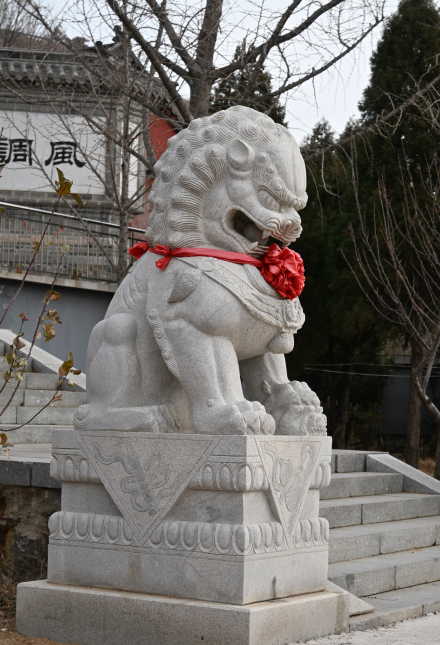
Alongside these discreet gestures, more visible symbols of protection reflect the richness of Chinese beliefs. Stone lions placed outside building entrances watch over the estate. They are believed to keep harmful spirits at bay and attract prosperity.
Around the neck or tucked beneath a shirt, jade amulets—often depicting benevolent figures such as Guanyin—accompany the workers, protecting their health and safety.
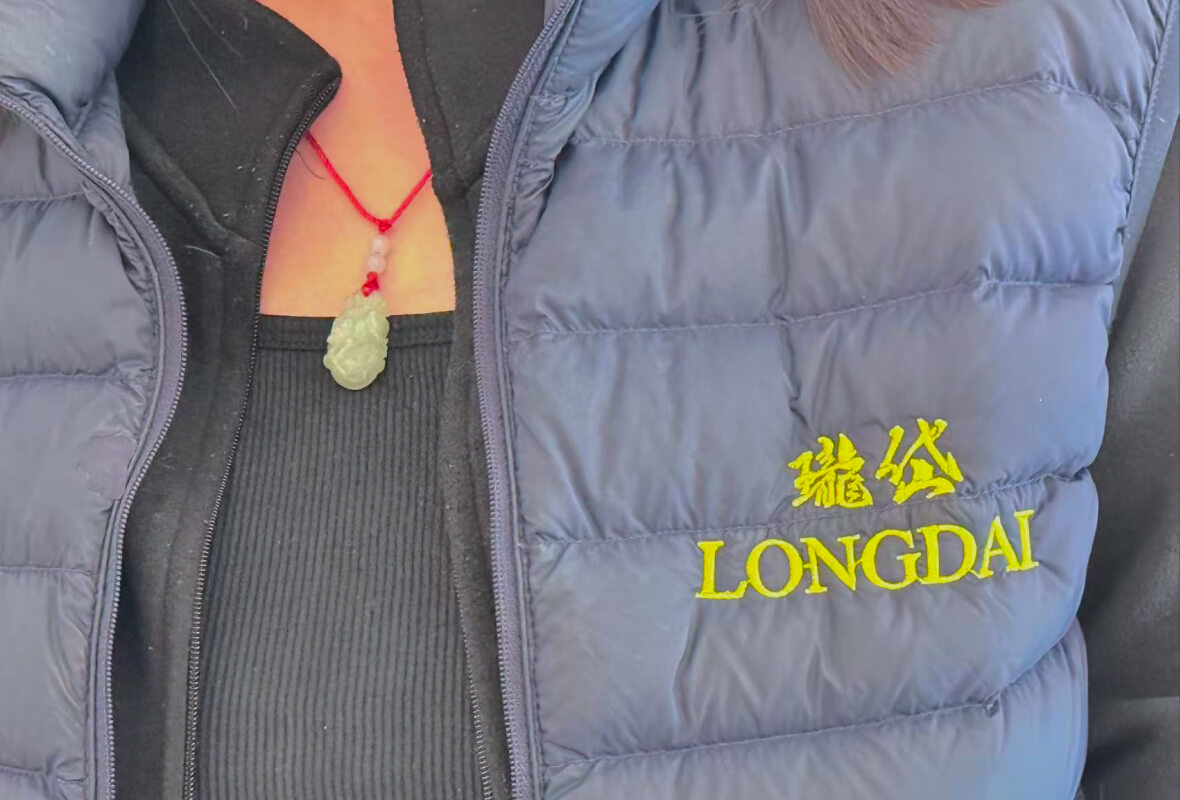
Here, the vineyard forms part of a landscape of signs, where spiritual protection extends the logic of agronomy.
At the other end of the world, Bodegas CARO, the Argentine estate of Domaines Barons de Rothschild Lafite, also has its rituals. The Virgen de la Carrodilla, celestial patron of the vineyards of Mendoza, blesses the fruit and the year’s labour during the Fiesta Nacional de la Vendimia. Her image, holding a bunch of grapes upon a carro vitícola, travels through cellars and fincas, recalling a faith born in response to the threat of hail. Along the desert roads, the Difunta Correa watches over travellers. At the roadside, small shrines fill with bottles of water left as offerings. Trucks carrying grapes often display her image, asking for protection on the journey.
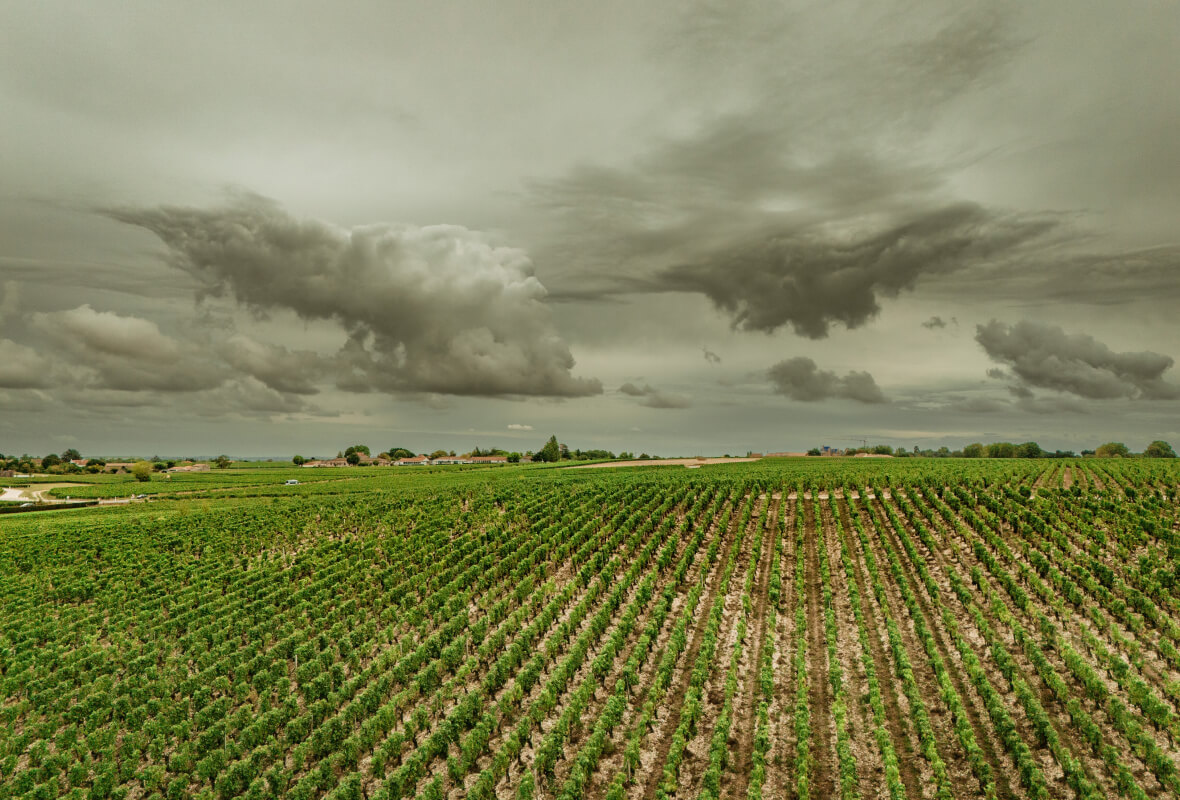
Out in the vineyards on the Altamira plateau, work continues with eyes fixed on the sky and guided by an older wisdom. Javier Garcia, Manager of Finca 99, and Numa Camille describe graniceros clouds: dark blue masses shaped like reeds, with pale fringes, accompanied sometimes by a distant rumble, like the sounds made by turbines. Storm fronts ascend from the south, clouds rise along the mountains, there’s even the scent of jarilla in the air. That earthy fragrance often signals rain approaching. At dawn, a single cloud in a clear sky can be enough for an experienced eye to declare with certainty: today, it will rain.
Offerings are made as well. A little wine from the previous vintage is poured over the first harvest bin as a sign of gratitude and good fortune. More discreetly, red ribbons tied around a wrist or a rear-view mirror guard against the mal de ojo, the evil eye. A tiny talisman against the unseen.
Moving on to the Andes in Chile, in the Colchagua Valley, the workers at Viña Los Vascos sometimes glance upward too, searching for the direction of the wind. ‘A north wind in spring or summer means rain is on the way.’
At harvest time, the team gathers for a long ‘Greek minute’, in truth closer to three minutes, accompanied by percussion. Workers help themselves freely from the vats and celebrate the end of the harvest. They also share pan de vendimia, a round loaf broken among the team at the close of each day’s red harvest.
Religion, naturally, still has its place. San Isidro Labrador, patron saint of farmers and rain, is invoked each 15th May through rural processions and masses.
Biodynamics: the return of rural wisdom and spirituality?
As science advances in the vineyard and technology reduces uncertainty, some inherited beliefs remain remarkably resilient. In some cases, they do more than survive. They make a comeback.
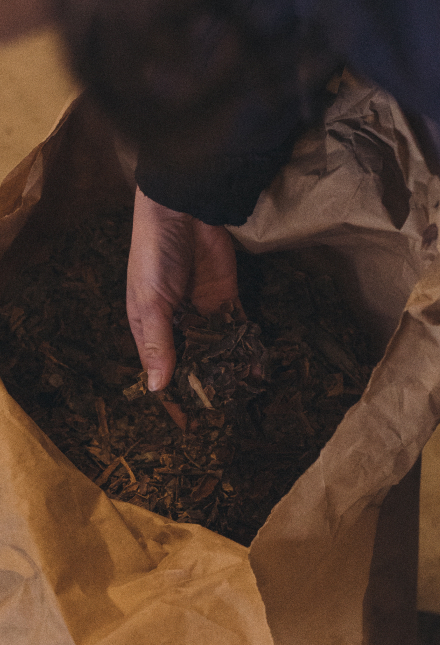
The rise of biodynamics over the past twenty years reflects a renewed interest in practices whose mechanisms are not always fully understood, yet whose effects on vines and grapes are often observed. For Manuela de Lachapelle, Head of Research & Development at Domaines Barons de Rothschild Lafite, it represents a form of rehabilitated rural common sense. (Read our interview.)
Whether they involve horns filled with cow manure, improvised altars in the vines, proverbs or patron saints, such rites remind us of the irrational dimension of the winemaker’s craft.
Perhaps even its spiritual dimension. When faced with the realisation that not everything can be controlled, ritual becomes a way of protecting oneself. In a way, it is also an admission of humility. It expresses belief, an act of faith before nature, whose unpredictable force remains impossible to master.
Untangling fact from folklore in the world of wine.
Deep-rooted traditions or ideas with no real basis? From Gregorian chants to the shape of a bottle’s base, here’s a look at some of the stories, rituals and myths that surround the world of wine.
In conversation with Manuela de Lachapelle, Head of R&D at Domaines Barons de Rothschild Lafite.
As Head of R&D at Domaines Barons de Rothschild Lafite, Manuela de Lachapelle explores what biodynamics, backed by evidence, brings to the resilience of Bordeaux estates and the redefinition of the winegrower’s craft.
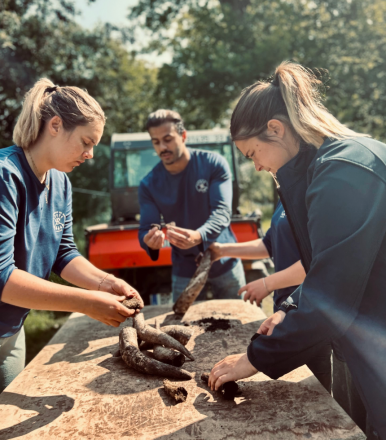
Digging deep to meet our vineyard’s smallest and most powerful allies.

In Search of Lost Calories