Weather: a lesson in humility, from folk wisdom to algorithms.
Whether guided by folk wisdom or modern forecasting models, farmers and winegrowers are searching for the same thing: a glimpse of what lies ahead. The weather, however, rarely offers certainty.
From halved onions on a windowsill to the most sophisticated forecasting models, farmers and winegrowers are all searching for the same thing: a way to see what’s coming. Between inherited lore and probabilistic science, the weather reminds us that making decisions often means acting without certainty.
Twelve onions for twelve months.
Reading the year in onions
At the end of every year, Rémy Gullung performs the same ritual.
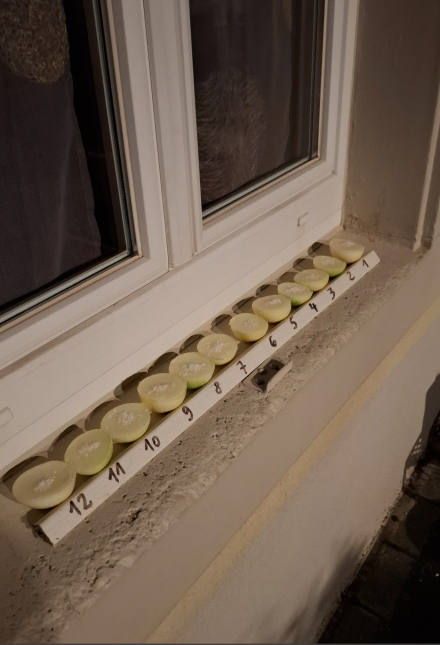
On Christmas night, the Alsatian from Hartmannswiller cuts six onions in half and lines them up on his windowsill. On each half he sprinkles a pinch of coarse salt. Twelve halves for the twelve months to come. Then he watches.
Where droplets form, the coming month will be wet. The onions that stay dry forecast dry spells.
Gullung—thick moustache, local accent—turns serious when he talks about his forecasts. And over the years he has built a reputation.
Across Eastern France, his name resurfaces every winter. People hear him on local radio. His predictions circulate on Facebook. Farmers discuss them in courtyards and wine cellars. They belong to a tradition passed down from one generation to the next, a legacy from a time when the first step in understanding the seasons was simply learning to watch the sky.
Several hundred kilometres away, in Pauillac, Louis Caillard starts his day very differently. As Vineyard Manager for Château Lafite Rothschild and Château Duhart-Milon, he checks his screens before dawn: weather models, radar images, pressure curves. By six in the morning, a decision might already involve dozens of workers and hectares of vines.
Two routines. Two methods. One shared question: what will the sky do next?
Let’s see what they say this year
Neither Rémy Gullung nor Louis Caillard deal in certainties.
One speaks of trends. The other speaks of probabilities. The language differs, but the principle is the same: the weather never reveals itself entirely.
‘A meteorologist should never be categorical.’
‘A meteorologist should never be categorical,’ Gullung says. His forecasts sketch the broad outlines of a year: a dry season, an unsettled summer, a mild autumn. He doesn’t revise them later. He stands by them, even when reality drifts away.
The attitude reflects an older farming tradition. In Alsace, the twelve days between Christmas and Epiphany were once believed to mirror the twelve months ahead.
Observing this petite année—the ‘little year’—was a familiar rural practice. Gullung’s grandmother, a market gardener, relied on it to plan her crops. Like many farmers of her generation, she had no radar and no models. What she did was pay attention: to the sky, the wind, the dampness in the air, the rhythm of the seasons.
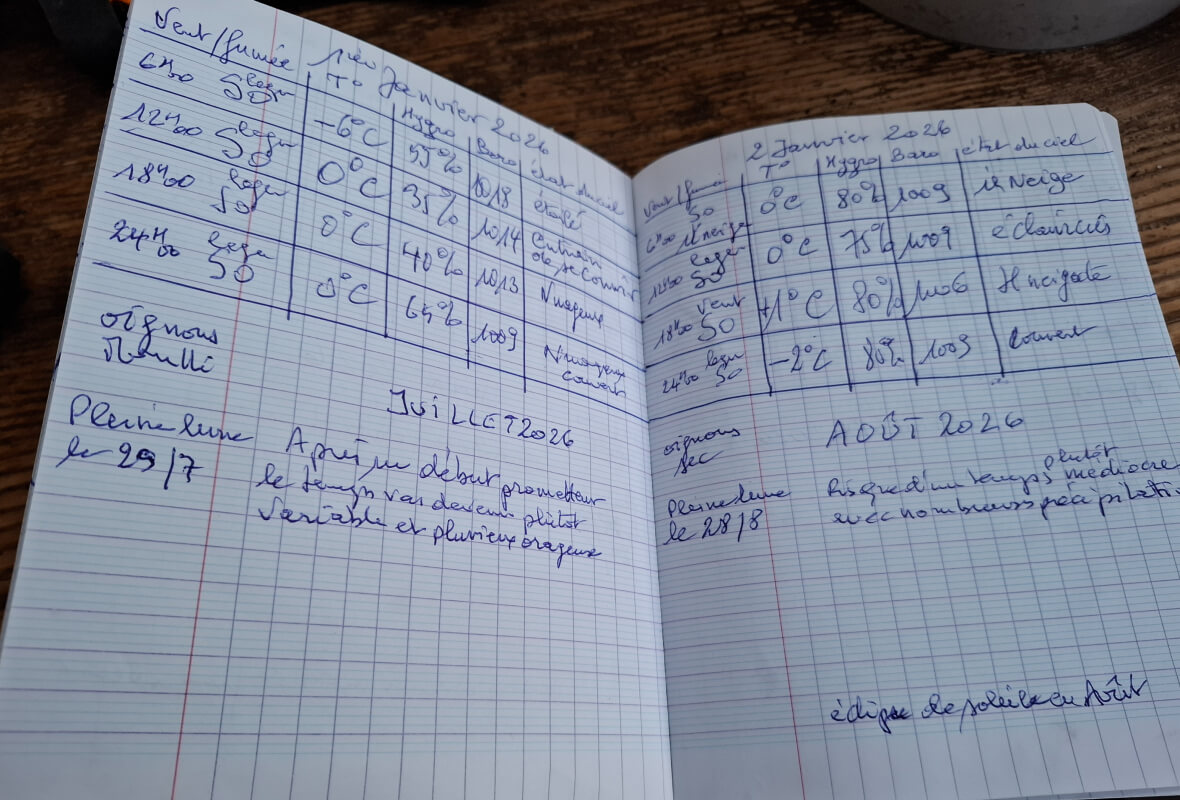
Gullung keeps a notebook filled with his yearly predictions.
If Rémy Gullung is still listened to today, it is not simply out of nostalgia. Many of the farmers and winegrowers who follow his forecasts learned the same seasonal cues from their parents. His audience extends well beyond curious amateurs. Some seasoned professionals also pay close attention to his predictions. François Ménin, Vineyard Manager at Domaine William Fèvre in Chablis, checks Gullung’s forecasts regularly and affectionately calls him ‘my Panoramix.’ The nickname, borrowed from the druid in the Astérix comics, is a playful way of acknowledging that even in the age of forecasting models and radar, inherited intuition still has its place.
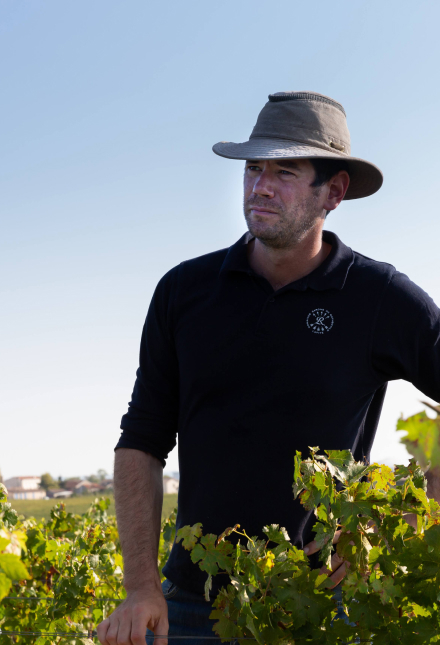
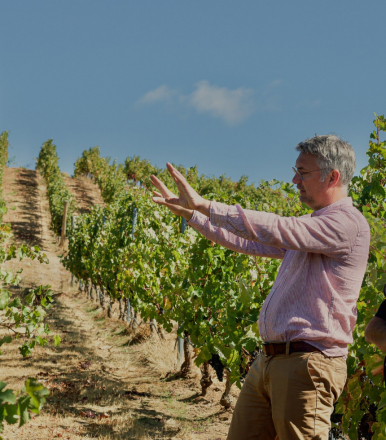
Louis Caillard, Vineyard Manager at Château Lafite Rothschild and Château Duhart-Milon.
‘Forecasting the weather is a bit like betting on a horse race.’
In Pauillac, Louis Caillard would not disagree.
The models he consults each morning integrate vast quantities of data: atmospheric layers, ocean temperatures, shifting air masses, prevailing winds. They attempt to anticipate the movements of a planetary system in which the slightest imbalance can alter the outcome.
‘Forecasting the weather is a bit like betting on a horse race,’ he says. The probabilities grow sharper, the scenarios multiply, but uncertainty never disappears.
Thunderstorms are a good example. Meteorologists may know they are coming. Predicting exactly where, and when, is another matter.
Between the onions on Gullung’s windowsill and the most advanced algorithms, the ambition remains the same: to reduce uncertainty without ever eliminating it.
A science of belief
At first glance, Gullung’s onions and modern forecasting models could hardly be more different.
On one side are inherited gestures and ritualised practices. On the other, a highly technical science built on satellites, data and computing power. Yet the two worlds are not as far apart as they might seem.
Many traditional weather beliefs began as careful observations, long before anyone had the scientific vocabulary to explain them. Louis Caillard has encountered many such examples during his career, in France and elsewhere.
In Spain, a winegrower once told him that when the stone steps of his cellar grew damp, rain was never far away. It sounded like folklore, yet there was a simple explanation: falling atmospheric pressure draws moisture up from the ground.
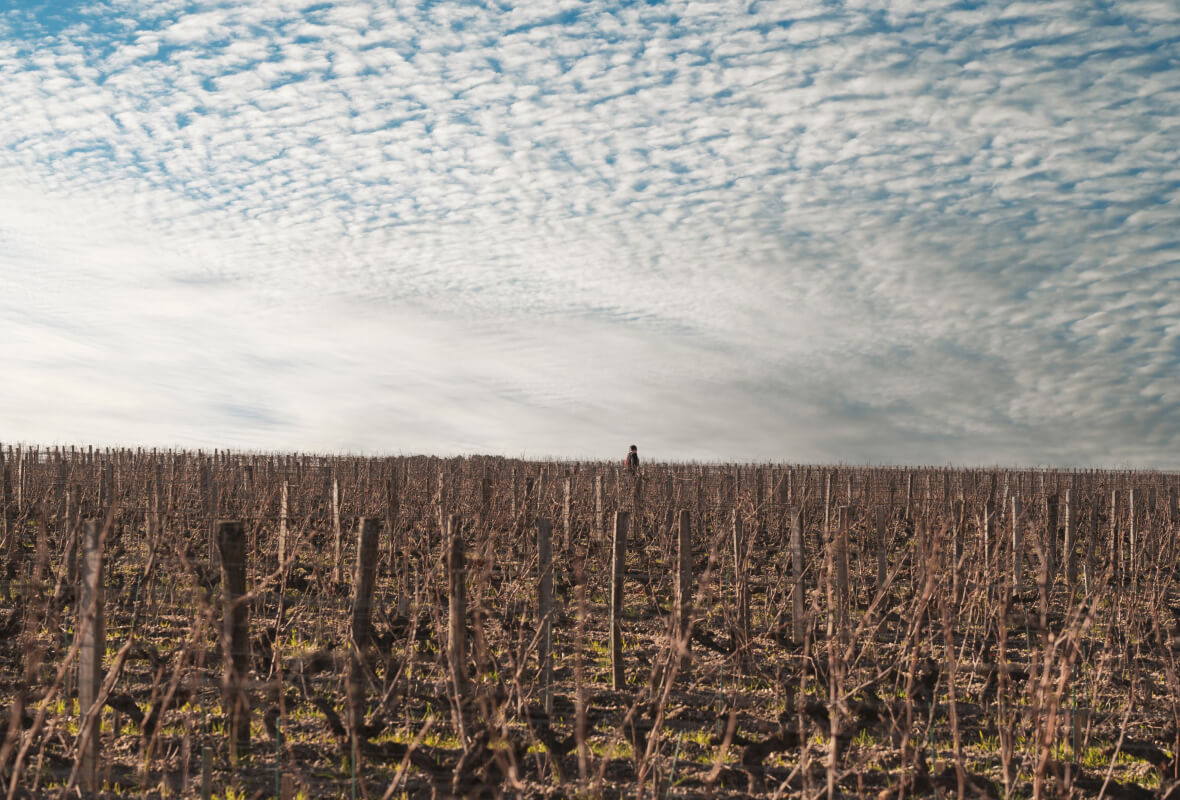
Other signs circulate from region to region. Swallows flying low before a storm. Aching joints that seem to anticipate bad weather. Or as an old French proverb warns us rather mysteriously: ‘Ciel pommelé et femme fardée ne sont pas de longue durée.’ Literally meaning ‘Dappled skies and painted women don’t last long.’ Beyond the hint of dated misogyny, we think the phrase refers to those fleecy clouds that often signal a sudden change in the weather.
‘Ciel pommelé et femme fardée ne sont pas de longue durée.’ An old French proverb we think refers to fleecy clouds that often signal a sudden change in the weather.
Gullung’s own approach is not so different. He does not claim exact science or absolute truth. Instead, he speaks of inheritance. Of attention, continuity and experience.
His methods are not meant to compete with modern meteorology. They simply remind us that long before satellites, people were already trying to read the sky. The knowledge was incomplete, but it was often practical.
Science itself does not eliminate doubt. It organises it. It measures it. Even the most sophisticated models remain fallible.
In both cases, the key lies less in believing than in staying attentive.
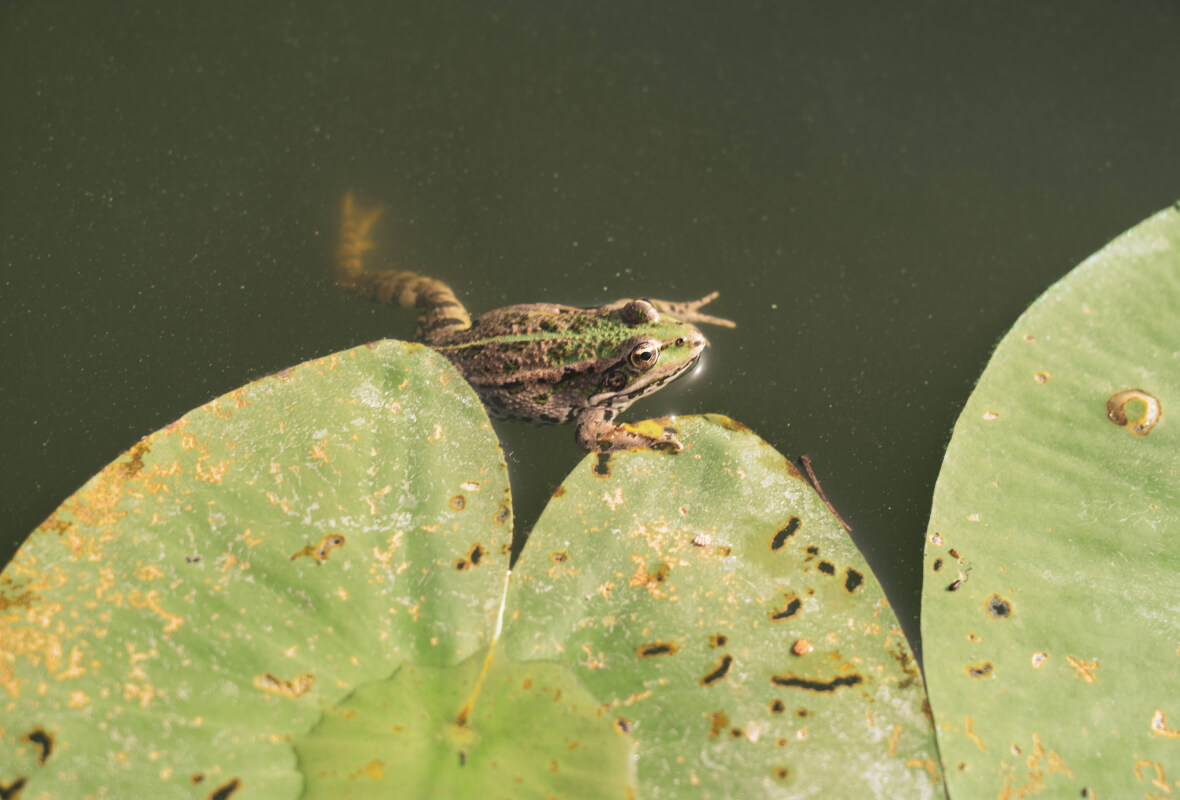
Frogs often appear in popular weather lore. One saying goes: if frogs croak during the day, rain will follow within three days.
A lesson in humility
Rémy Gullung and Louis Caillard inhabit very different worlds. Yet they share the same humility in the face of the sky.
One turns time into ritual, hoping to make it legible. The other turns it into data, hoping to anticipate it. Predicting exactly where and when is another matter.
In the end, the goal is not to promise certainty, but to learn how to act despite uncertainty.
Or, to borrow a thought often attributed to the Stoic philosopher Seneca: there is no such thing as bad weather, only inadequate equipment.
Read also
Biodynamics: from belief to evidence
In conversation with Manuela de Lachapelle, Head of R&D at Domaines Barons de Rothschild Lafite.
As Head of R&D at Domaines Barons de Rothschild Lafite, Manuela de Lachapelle explores what biodynamics, backed by evidence, brings to the resilience of Bordeaux estates and the redefinition of the winegrower’s craft.
In our cellars, we blend grape varieties; in our Journal, we blend ideas. This time, it's a rather airy lexicon. The winds make the weather fair or foul. But do they also make the wines? Here's an overview of those that blow over our vineyards, from the tramontane to the typhoon.
Adapting our understanding of terroir for a warming climate.
Olivier Trégoat, Technical Director for Domaines Barons de Rothschild Lafite, argues for a more flexible understanding of terroir, one freed from rigid dogma, to adapt to the realities of climate change.
The inner thoughts of two winemakers from opposite ends of the world.
What does a winemaker’s day really look like? The journals of Jeanne at Château L’Évangile in Pomerol and Joaquín at Viña Los Vascos in Chile reveal two contrasting yet connected lives. This is the story of two different hemispheres and one shared passion.