It is a cold January morning in Léognan. Mist drifts through the streets of the town centre, softening the façades and wrapping the church tower in a pale, milky scarf. The air is damp. Coat collars are turned up, and the few passers-by leave small clouds of breath in the air.
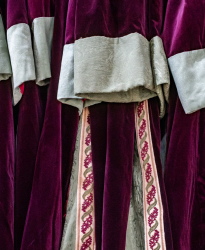
It is not yet ten o’clock when the first cloaks appear. Their violet sheen pierces the fog. Moiré fabrics, heavy velvet. Figures begin to gather. Reds, yellows, whites come into view. Slowly, a colourful procession emerges from the mist, as if from another century.
Behind the guild’s banner, the procession crosses Léognan in full ceremonial dress.
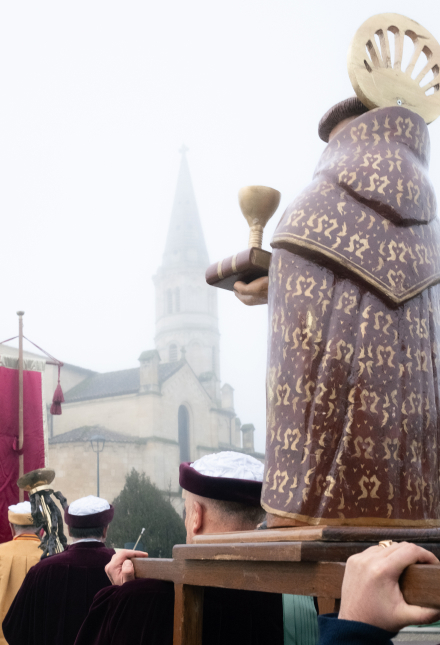
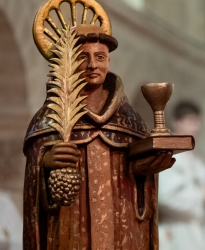
At the front, two drums break the silence. Then the statue appears. Saint Vincent rises above the column. The gilded, time-worn wood contrasts with the brilliance of the robes.
The procession advances towards the church. Along the pavements, people pause. Car engines fall silent. A window is lowered, a phone appears. The scene attracts a certain curiosity.
Behind the procession
Let’s turn back the clock a few hours. Before the procession. Before the drums and the statue.
At 9.30 a.m., just beside the church, the Commanderie du Bontemps gathers in the market hall of Léognan. Sheltered from the cold and from curious eyes, the ritual begins to take shape.
People greet one another as they do every year. Embraces, handshakes, a friendly pat on the shoulder. Some speak as old friends; others introduce themselves for the first time. The veterans welcome the newcomers. Voices mingle, cheerful, attentive, occasionally teasing.
Amid this movement, one figure draws the eye. His robe is the same as the others, but a golden chain rests on his shoulders. Later, a sceptre will appear in his hands.
He is the Grand Master, Emmanuel Cruse.
He moves from group to group, exchanging a few words, checking that everything is in order. The title itself raises a smile. Emmanuel Cruse laughs at it too.
‘Yes, the terms are rather grand,’ he says. ‘They probably echo certain old lodges from the Masonic era. So I have the honour of being Grand Master without being a Freemason.’
Yet for him the Commanderie is not a relic of the past but a point of balance.
‘What we protect here is not tradition for tradition’s sake. It is a way of remaining together. Wine is a collective endeavour. If we forget that, everything fragments.’
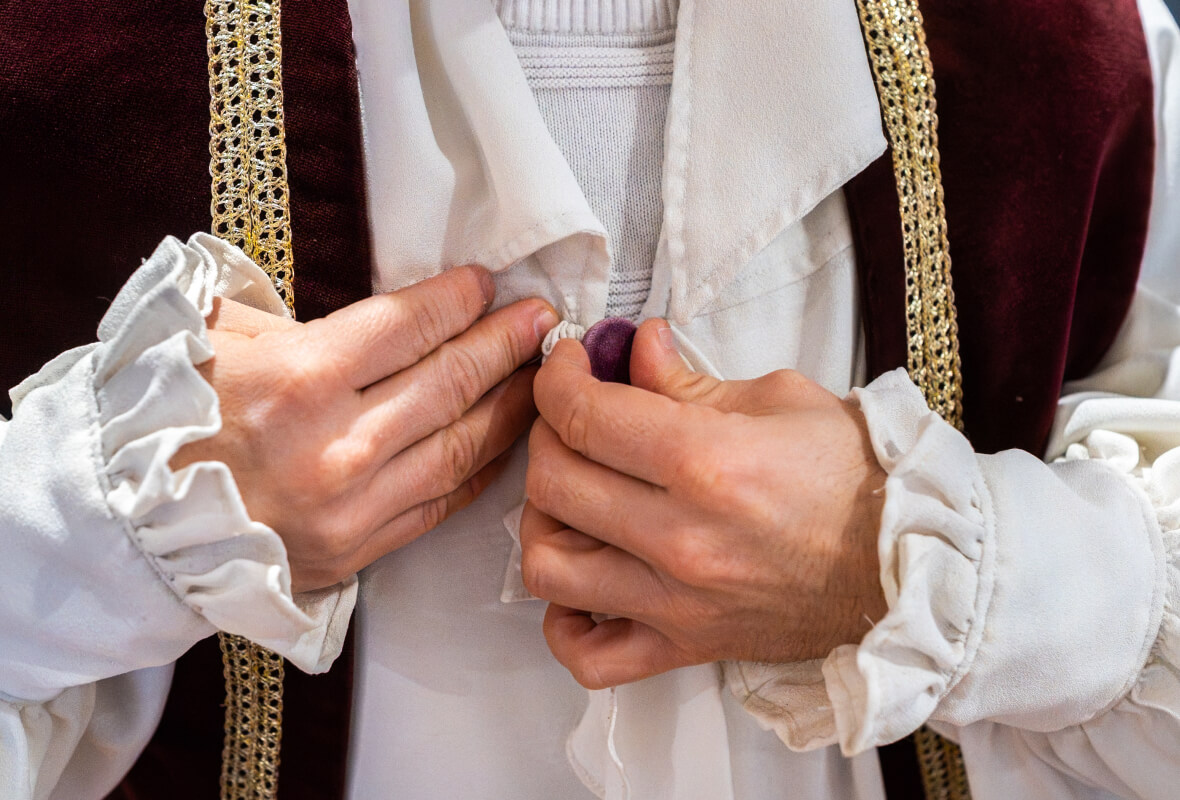
In one corner someone adjusts a lapel, elsewhere a cloak is carefully fastened. The gestures are attentive, sometimes a little awkward. These cloaks are not worn every day.
Roles are assigned according to the protocol: the halberdiers who will accompany the Grand Master, the bearers of Saint Vincent, the musicians, the person who will carry the banner, the new wine, the fibulae.
Before the ceremony begins, the roles fall into place. And where there is a role, there is a costume.
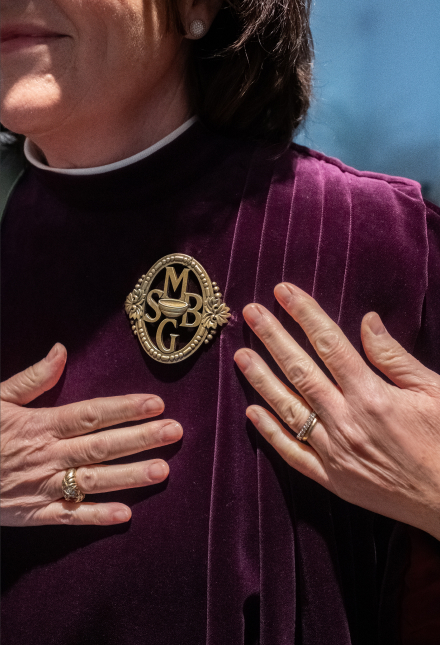
The fibula is the emblem of the Commanderie. It adorns the robe of each Commander and bears the initials of the order, along with the bontemps, a legendary whisk once used by cellar masters to beat the egg whites used to clarify wine.
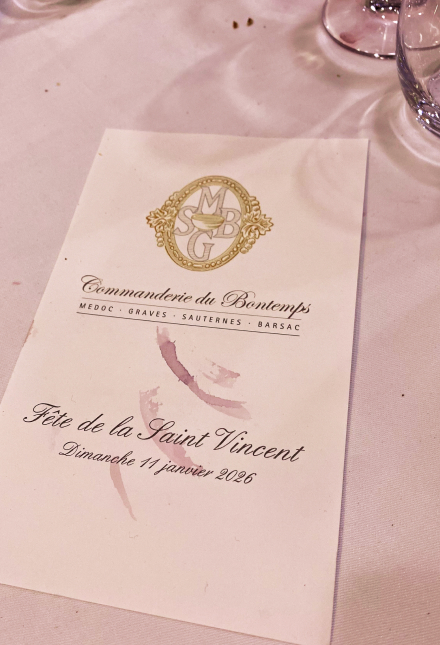
The Commanderie du Bontemps was revived in 1949, at a time when the Bordeaux vineyards were rebuilding after the war. Its founding idea remains unusual even today: to bring together, under one banner, those who produce wine and those who distribute it.
Since then, thousands of people have been inducted. And on this morning in Léognan, the Commanderie takes shape once again, through the repetition of roles and through a simple idea that will echo throughout the day: wine thrives best when it is shared.
Entering the rite
Back to the procession. The column enters the church. Inside, the air carries the scent of incense and cold wax. Cloaks brush against the stone floor, halberds ring softly as they touch the flagstones. The drums fall silent.
The church is already full for the Sunday Mass. Families, elderly parishioners, altar servers. An ordinary Sunday, were it not for the unusual procession crossing the nave. On a side altar, three ceremonial plumed helmets from the Saint-Cyr military academy rest in place. Uniforms mingle with albs and cloaks. Clearly, this is a day for costumes.
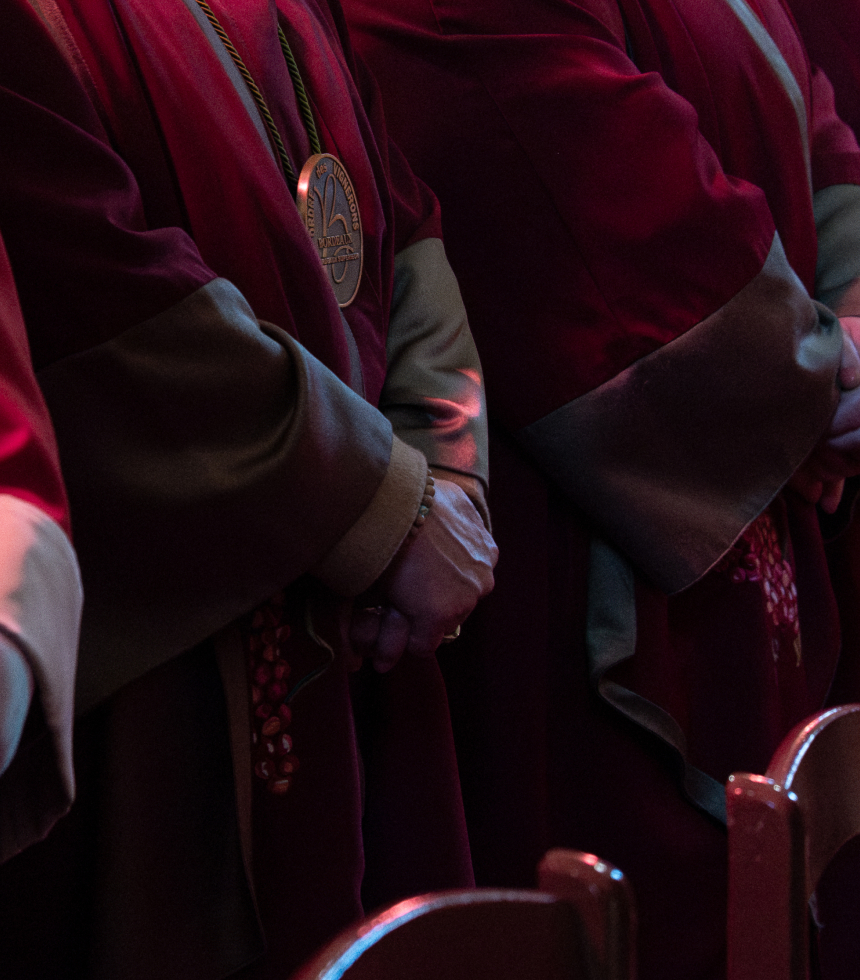
Not all of them share the same colour. Some cloaks come from elsewhere. The bright red of the Jurade of Saint-Émilion stands out among the violets. A guild bound by friendship and shared values.
‘These institutions are not here to defend a single château or a name, but an appellation,’ someone explains. ‘We meet because we share the same profession and the same vulnerabilities.’
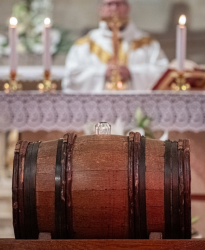
The statue of Saint Vincent is placed near the altar. Beside it stands a barrel containing the new wine. Through it, all the wines of the Left Bank are symbolically represented: Médoc, Graves, Sauternes and Barsac.
The ceremony begins. The priest’s words echo beneath the vaulted ceiling. He speaks of labour, of effort, of a difficult year. He speaks also of solidarity and unity.
The new wine is presented and blessed.
In the congregation, bodies adopt the same posture without instruction. Hands clasped. Heads bowed. Silence.
When the ceremony ends, the doors open. Cold air enters and the procession steps back outside.
The ritual continues.
You have to taste it to believe it
The moment one enters the dining hall, camaraderie quickly replaces the solemnity of the religious ceremony. The tables are bright, covered in white linen. Yet what catches the eye are the glasses. Rows upon rows of glasses, lined up at every setting.
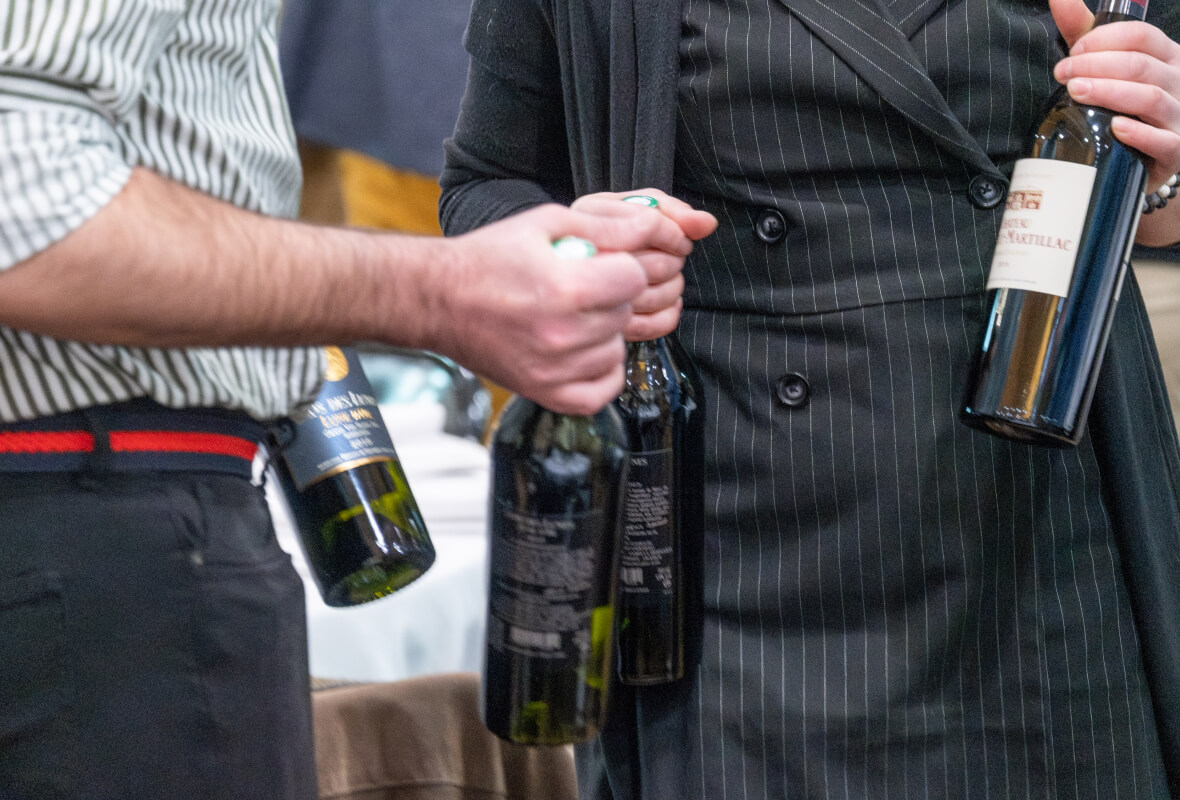
Winegrowers move through the room with bottles in hand. They pour, share, taste. A handshake is exchanged for a vintage. The barter is spontaneous and joyful. Each person wants to introduce their wine, but also to taste the others.
It resembles a marketplace without money. An organised chaos where labels are recognised from across the room and conversations already turn to the juice, the vintage, the weather.
Before the speeches begin, wine passes from hand to hand and bottles gather across the tables.
Amid this lively disorder, Emmanuel Cruse surveys the room. He often says that the uniqueness of the Commanderie du Bontemps lies not in the ceremony itself, but in what it brings together.
‘For once, production and distribution stand under the same banner. Estates, cooperatives, traders, brokers. We’re all in the same ring.’
Watching the bottles circulate freely from table to table, the point becomes obvious.
In the midst of the bustle, the induction ceremony begins. Conversations quieten and attention turns towards the stage. Names are called one by one. Each initiate steps forward. A Commander places a cloak over their shoulders in a gesture that is simple yet solemn. Then comes the test: a tasting. A glass, and a few words to describe it. Nothing overly academic, but enough to show that one knows what one is talking about.
Above all, that one accepts the spirit of the occasion.
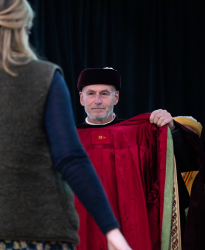
The placing of the cloak seals the induction. Pictured here: Éric Kohler, Technical Director of Château Lafite Rothschild and Château Duhart-Milon.
The cloak seals the induction. Next, the fibula and a signed diploma. Finally, twelve blows struck upon the barrel of new wine confirm the ceremony, beneath the steady gaze of Saint Vincent.
Among the day’s new Commanders is Rodolphe, an accountant by training. For him the honour is a form of recognition, a way of entering a circle built on co-option and transmission. He has been attending the ceremony for twenty years. The induction simply formalises that loyalty.
For Isabelle, a wine influencer working in both China and France, the ritual carries another meaning. In China, she explains, proving the authenticity of the wines one sells is essential, as fears of counterfeits remain strong. Wearing the cloak of a recognised guild becomes tangible proof. Across borders, the cloak inspires confidence.
Paloma Sénéclauze, Managing Director of Château Marquis de Terme and a recent inductee, admits that joining such an institution can initially feel intimidating. Being a young woman in a highly codified world historically dominated by men might seem restrictive. Yet she sees it differently.
‘Everyone understands today that things must evolve,’ she says. Doors are opening to people who once stood on the margins. She speaks of a genuine shift, visible in everyday practice. There is also a conviction: ‘One should not be intimidated by the rites, but use that difference to move them forward from within.’
The circle of the guild
Once the inductions are complete, the room does not empty.
Cloaks are hung aside and the meal begins. Conversations return, now turning to travel, distant markets, projects yet to come.
Perhaps this is where the Commanderie reveals itself most clearly, when the ceremony fades and what it makes possible comes to the fore.
Behind the cloaks and ancient titles lies a thoroughly contemporary mechanism. Rites open doors. Inductions create networks. Each member becomes an ambassador, an anchor point somewhere in the world.
Yoyo Maeght, inducted that day, recognises something familiar in this model. At the gallery openings of her childhood, she recalls, artists existed side by side without cancelling each other out. Miró, Giacometti, Chagall and Calder were not direct competitors. Each affirmed a strong identity while belonging to the same artistic landscape.
For her, guilds work in much the same way. Competition momentarily recedes in favour of the collective. Wine becomes a shared creation, carried by singular styles yet rooted in a common territory.
By the end of the afternoon, the tablecloths are stained and glasses stand half-empty.
Outside, the mist has lifted. Léognan returns to its usual rhythm, a Left Bank town settling back into the calm of a Sunday afternoon.
In the boots of departing cars, bottles exchanged during the day are already travelling towards other tables, other glasses, other encounters.
The ritual is over. Its spirit lingers.
Read also
Dragons, roses and ladybirds
Untangling fact from folklore in the world of wine.
Deep-rooted traditions or ideas with no real basis? From Gregorian chants to the shape of a bottle’s base, here’s a look at some of the stories, rituals and myths that surround the world of wine.
Celebratory notes: memories of Lafite’s 150th anniversary
A look back at three unforgettable dinners held in May 2018 to celebrate the 150th anniversary of Château Lafite Rothschild — an event attended by distinguished guests from all walks of life.