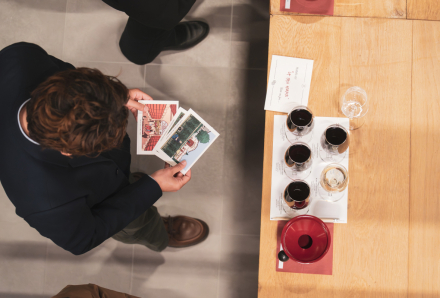
We rarely blind taste. Truly blind. Without reference points, without labels, without that cluster of cues that guide, and sometimes distort, our judgement. Price, reputation, vintage, even context, each is enough to shape what we perceive.
In 2008, an experiment conducted by Stanford and Caltech demonstrated this clearly. Twenty participants tasted wines while undergoing MRI scans. In reality, there were only three wines, presented under different price points. The result: the very same wine was rated significantly higher when labelled at $90 than at $10. The brain, it seems, tastes expectations as much as it does wine.
So what remains when you strip everything away?
Appearance, aroma, palate, finish…and you.
Now it’s your turn.
At each stage of the tasting, match the correct description to the corresponding sensation. By connecting your choices, you’ll identify a wine…or, failing that, discover your talent for improvisation.
Clues
A deeper, more purplish red, dense with bright highlights
A garnet red, deep but not opaque
A luminous white, fairly dense, with golden reflections in the light
A visually pleasing wine, broadly red…certainly not orange
Options
A. A wine already in a phase of balance, its structure softened with time A Left Bank Bordeaux such as Château Duhart-Milon, or in a similar style, Domaine de Long Dai
B. A younger, more concentrated wine, with plenty of substance still present A sun-drenched red, such as Le Dix de Los Vascos or CARO
C. A wine built on freshness and tension A great white, such as Domaine William Fèvre or Blanc de Duhart-Milon
D. A visually flawless wine, almost too polished A wine that clearly prioritises first impressions…but clothes don’t make the man
Answers: 1×B, 2×A, 3×C, 4×D
Clues
Citrus, freshness, a hint of minerality
A discreet nose, inclined to open up, if it chooses to impress
Clean, precise black fruit, without excess
Riper fruit, more expressive, with a spicy edge
Options
A. A slightly restrained profile that rewards patience with finesse A classic Bordeaux such as Château L’Évangile or Duhart-Milon
B. A more open, immediate expression, with marked ripeness A sunnier style, such as Le Dix or Bodegas CARO
C. A profile driven by freshness, precision and real tension A great white, such as Domaine William Fèvre or R de Rieussec
D. A nose open to interpretation A wine that depends largely on the person describing it
Answers: 1×C, 2×D, 3×A, 4×B
Clues
Broad, enveloping sensation
Lively, taut, almost nervy palate
Supple, easy, immediately appealing
A clean, precise attack, without marked softness
Options
A. A precise structure, with good hold and well-integrated tannins A mature Bordeaux such as Château Duhart-Milon or Lafite
B. A broader, more expressive texture, with a sense of generosity A sun-driven wine, such as Le Dix or CARO
C. A dynamic driven by freshness and energy rather than volume A white, such as William Fèvre or Aussières Blanc
D. A consensual, well-shaped palate A wine that pleases everyone without imposing itself
Answers:1×B, 2×C, 3×D, 4×A
Clues
A warm, ample finish
Impressive persistence
A taut, fresh, almost saline finish
A finish that’s hard to define, yet clearly present
Options
A. The hallmark of a refined wine that stretches out effortlessly, without excess A classic Bordeaux such as Duhart-Milon or Carruades de Lafite
B. The signature of a sun-driven wine Such as Le Dix or Château d’Aussières
C. The sign of a seductive great white Such as Domaine William Fèvre
D. A finish that depends largely on how convincingly you describe it A wine that benefits from confident storytelling
Answers:1×B, 2×A, 3×C, 4×D
By linking your answers:
A = Château Duhart-Milon (2010–2015)
A quintessential Pauillac: deep garnet colour without opacity, a slightly reserved nose, a structured palate with already integrated tannins, and a steady, elegant finish—more refined than showy.
B = Le Dix de Los Vascos (2016–2021)
A sun-driven, concentrated wine: deeper, more purplish hue, aromas of ripe fruit and spice, a broad and enveloping palate, and a warm finish.
C = Domaine William Fèvre, Bougros Grand Cru (2020–2023)
A taut, great white: luminous appearance with golden highlights, citrus and mineral notes on the nose, a lively, energetic palate, and a fresh, almost saline finish.
D = If you didn’t quite pin down the wine, you may have chosen to bluff.
We encourage you to persist. Close your eyes, adopt a look of quiet conviction, and spin a story worthy of a well-travelled sommelier. The more precise it sounds, the less verifiable it becomes.
For example:
‘North-west facing parcel, hand-harvested by Jean, a former banker turned vigneron. His wife left him…poor man. Luckily, he has Jack, his Jack Russell, faithful companion in this new life, reviving a forgotten grape variety. Marcelette…ah, you’ve never heard of it?’
Read also
A very eloquent nose
An interview with assemblage expert Alexandre Schmitt.
Alexandre Schmitt made a dramatic shift from the world of haute parfumerie to another field equally bound to aroma: wine blending. He shares the essence of his sensory-driven approach—and explains why training your nose is essential to tasting wine.
Exploring the aromatic life of the grape, a delicate dance between nature and science.
At Domaines Barons de Rothschild Lafite, a wine never reveals itself all at once. Aromas of strawberry, mint and mocha lie hidden in the berry, emerging gradually through fermentation, ageing and time. A molecular masquerade, orchestrated by the human hand.