Exploring the aromatic life of the grape, a delicate dance between nature and science.
At Domaines Barons de Rothschild Lafite, a wine never reveals itself all at once. Aromas of strawberry, mint and mocha lie hidden in the berry, emerging gradually through fermentation, ageing and time. A molecular masquerade, orchestrated by the human hand.
Bury your nose in a glass. What do you smell? Strawberry. Black cherry. A whiff of peppermint, perhaps? Sometimes a hint of mocha or, rarer still, paprika. But there’s none of that in reality. No berries. No herbs. No spices. Just grapes, and what you might call ‘a masquerade ball of aromas’.
‘Wine is nothing more than fermented grapes. But these grapes have more than one trick up their skin,’ smiles Manuela de Lachapelle, Director of Research and Development for Domaines Barons de Rothschild Lafite. ‘Many aromas are present inside the berry, but in hidden form. Fermentation sets them free.’
In the vineyards of Château Lafite Rothschild, Château L’Évangile and Vina Los Vascos, ‘the ball’ begins long before bottling.
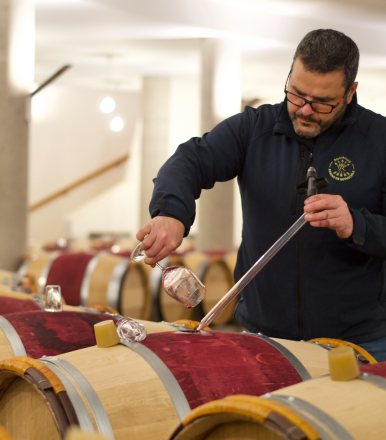
In the glass, Manuela de Lachapelle conducts a sensory investigation.
Behind the mask lie aromas
Wine moves through life in disguise. And its aromas, like dancers at a masquerade, reveal themselves only as time unveils them.
There are three main families:
Primary aromas, tied to the grape variety. Born in the vineyard, carried by the fruit. Muscat smells of, well, muscat. A well-exposed Sauvignon Blanc can already hint at mango, passionfruit or, brace yourself, ’cat’s pee’, a euphemism for what winemakers politely call ‘boxwood’ or ‘blackcurrant bud’.
Secondary aromas reveal themselves during alcoholic fermentation. Yeasts, acting like enzymatic scissors, cut the bonds between aromatic molecules and the sugars they were bound to. The so-called glycosylated precursors. This is the moment the mask drops. Freed, the aroma takes the stage.
Cabernet franc and Sémillon.
Finally, the tertiary aromas of long ageing emerge as oxygen quietly works its spell. Tobacco, leather, mocha, undergrowth, these aromas are subtly forged over time.
‘An aroma molecule can be present but undetectable, because it’s bound to something else. Like a disguise. When the yeast acts, it severs the tie and the aroma appears,’ explains Manuela.
‘Take violet: you may not sense it in the berry, but once fermentation begins, it comes forward, clean and clear, freed from the sugar that held it. It was there all along, just invisible.’
Manuela de Lachapelle
At Lafite, the aim is less to force the aromatic profile than to preserve it. ‘Cabernet Sauvignon is naturally very rich in aromatic compounds. The goal is to keep that freshness, protect the primary aromas while developing the rest.’
The influence of climate…and human choice
How can a wine smell of strawberry, cherry or plum, without containing any of those fruits? Because grapes share families of molecules with them.
Strawberry, for instance, is linked to fruity esters (like ethyl butanoate) that can be produced during fermentation. But their expression depends on many factors: grape variety, ripeness, yeast, temperature, winemaking style. Sometimes, just a few days can tip the profile.
In 2020 at Château L’Évangile, Manuela recalls a heatwave that turned fresh strawberries into jam. ‘The grapes picked before the heatwave gave pure, crisp aromas. Those harvested after leaned toward cooked fruit.’ Two days apart. Two faces of the same fruit: a bright gariguette strawberry one day, a jar of jam the next (or if you want to be more precise, the day after). Time plays a crucial role in the world of aromas.
It’s all about balance. At L’Évangile, harvest now leans earlier, to catch that fresh strawberry. At Lafite, the focus is clear: protect freshness, magnify the elegance of the tannins, never overplay your hand.
Carménère’s aromatic potential and ripeness can be assessed directly in the vineyard and are generally translated clearly into the wine.
From the Medoc to Chile, the mask changes, but the dance stays the same.
On the Los Vascos estate, Carménère also dances along the tightrope of aroma, but in a different register: pyrazines, the molecules that recall bell pepper or peppercorn. It’s the variety with the highest pyrazine content—up to a hundred times more than Cabernet Sauvignon.
Here too, it’s all about timing: harvest too early and pepper dominates; too late and the vegetal note fades, only to return, blended with jammy notes and astringent tannins. Always the last grape picked, Carménère is brought in at the precise moment when red and black fruits take the lead, without losing the variety’s spicy signature.
Barrels or amphorae: each vessel shapes the tertiary aromas. Wood, volume, porosity… every nuance influences the wine’s evolution.
Ageing: the final act of the ball
If fermentation is the grand opening, ageing is a slower, more intimate pas de deux. This is where tertiary aromas take shape. Here again, every detail counts: the size of the vessel, its material, its oxygen permeability. Large oak casks, barrels, concrete tanks, amphorae—choose your dance partner wisely.
‘When a wine is described as “open”, it often means it’s had too much oxygen,’ warns Manuela. ‘You can go from fresh fruit to heavy prune compote. That’s not what we’re after.’
At Lafite, the sought-after evolution includes mint, tobacco, sometimes hints of mocha in the most expressive vintages, like 2010—olfactory signatures that add depth to great wines built for ageing.
Even in the glass, nothing is fixed. ‘An aroma can appear, vanish, then return. The wine breathes. It evolves in open air, sometimes within minutes.’
Behind this fluidity lies the taster’s own memory and sensory map. ‘I grew up in Colombia, so I pick up all the tropical fruits in wine, but I have fewer floral references. I refer to my own dictionary,’ says Manuela. ‘Wild strawberry, for me, is feijoa. Violet is raspberry.’
That’s why aroma wheels, shared tools to align our noses, are so useful. ‘We use the same wheel at Lafite and L’Évangile, but the descriptors differ. At L’Évangile, we avoid jammy or woody notes. At Lafite, we value freshness, verticality, the clean precision of the fruit.’
Aroma wheels, collective tools to align palates during the making of wines.
Wine is a game of patience and precision. A delicate dance between nature, science and the human hand, carefully orchestrated so the rhythm never stops.
Read also
Breathe Deep: Rituals of a Cellar Master
In search of lost rituals. Once de rigueur, some winemaking techniques have given way to newer practices. Today, innovation is not without tradition.
An interview with assemblage expert Alexandre Schmitt.
Alexandre Schmitt made a dramatic shift from the world of haute parfumerie to another field equally bound to aroma: wine blending. He shares the essence of his sensory-driven approach—and explains why training your nose is essential to tasting wine.
In each issue’s ‘Assemblage’ section, we compose a blend of shorter snippets relating to a theme. This time, we explore forgotten or misunderstood vintages that, with the passing of time, revealed their true brilliance. Like certain songs or works of art that only find their audience years after their debut, these wines waited patiently—until the moment was right for them to be truly appreciated.
How winemakers use their teeth to pick the perfect day to harvest.
Every year as harvest nears, the teams at Domaines Barons de Rothschild Lafite taste the berries, chew the skins and crack the seeds between their molars. Discover how berry tasting, one of the last purely sensory skills in the hyper-analytical world of wine, influences the harvest.