Explore the hidden orchards and gardens behind the vines.
A journey across three vineyards where fig trees, rose bushes, chaguals and quinces extend the work of the vine, reveal the rhythms of the seasons and strengthen the vitality of the soil.
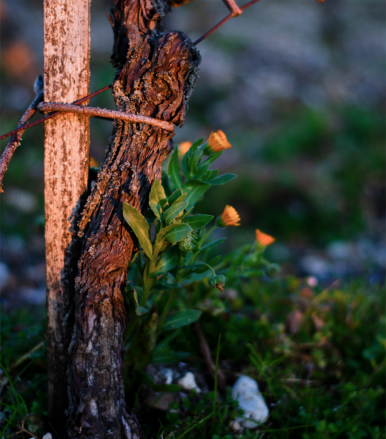
A vineyard can be taken in at a glance: rows aligned like a musical score, leaves neatly trellised, clusters on display. Yet behind this curtain of foliage, other varieties often go unnoticed – gnarled fig trees, almond blossoms, hedgerows alive with secrets, wild grasses, humming bees, wandering sheep. A quiet, yet powerful, biodiversity.
At Domaines Barons de Rothschild Lafite, every terroir speaks to its environment, a constant dialogue between land and life. This is a look at three vineyard-orchards where biodiversity grows as naturally as summer fruit.
Three living vineyards: from Colchagua Valley to the Médoc, by way of the Corbières
Viña Los Vascos — Colchagua Valley, Chile The garden in the rocks
At Los Vascos, fruit grows where you least expect it. Between sun-warmed stones, eroded hillsides and the furrows carved by Pacific winds. It’s a scattered orchard, free like a playground, planted in the folds of central Chile. Cherries, figs, plums, olives, citrus, walnuts, pistachios: a short walk is enough to find them. The trees answer one another in silence, scattered by human hands and the whims of the soil.
Across 3,600 hectares, vines occupy only a sixth of the land. The rest? A mosaic of native species, endemic plants, preserved sclerophyll forests, and nourishing gardens. The estate chose to let nature breathe rather than fence it in. A centennial olive tree meets a playful lemon tree. A quince dreams beneath a fig. A cherry ends in a winemaker’s hand, like a candy before its time.
A natural reserve, Los Vascos is home to countless bird species in the lush Colchagua Valley, including the giant hummingbird.
Fruit trees abound. Some feed the teams or the birds, others are harvested and sold: plums, walnuts, and olive oil find their way to market. The rest—pistachios, walnuts, pear or plum trees—bear witness to experimentation, sometimes simply to a gardener’s pleasure. Each tells its own story: a whim, a patch of shade, a wager.
Beside these cultivated orchards thrive Chile’s endemic plants. The Chagual, a plant with a thousand virtues, holds a singular place. Its spectacular rosettes now embody the wine Los Vascos Chagual. But it shares this sentinel role with other local species: the Koyle, with its small edible fruit; the Canelo, whose berries yield the Pimienta de canelo; the wild oregano known as oréganillo; or the boldo, used in therapeutic infusions and even in ice cream served at La Casona.
In this thriving ecosystem, cultivated and wild echo one another, weaving a mosaic where every plant has its place and its function.
The Chagual, a plant with a thousand virtues, embodies the Los Vascos Chagual wine.
Native to the Chilean Andes, the Chagual (Puya Chilensis) belongs to the bromeliad family, like the pineapple. Its spiny rosettes unfold into a spectacular inflorescence that can rise several meters high. Once eaten in rural kitchens for its sweet, crunchy heart, it is now preserved: the Chagual is today a protected species in Chile.
At Viña Los Vascos, it no longer feeds the stomach but the soil. It stabilises poor slopes, prevents erosion, shelters young shoots, and attracts birds. In fragile areas of the estate, it is planted to help nature reclaim its rights. A true botanical sentinel, it embodies transmission: resisting droughts and wildfires, then yielding its place to those that follow.
As the symbol of the organic cuvée that bears its name, the Chagual tells a story of resilience and time.
Aussières — Corbières, Languedoc The workshop of the seasons
At Aussières, fruit grows at arm’s reach. In the folds of the hills, along dry-stone walls, beside forgotten paths. Almonds, quinces, figs, persimmons, peaches—each season has its totem fruit, each tree its familiar silhouette. Between Narbonne and Fontfroide, the estate stretches across 550 hectares. Olive trees precede the vines, almond trees punctuate clearings, fruit trees cling to slopes like old tales barely told.
They give when they wish, as they can. Some have stood for decades, perhaps a century, weathering droughts and storms. Their presence is not always explained. They are kept for their shade, the grace of their trunks, or the sudden acidity they add to an improvised dish. They are part of the landscape, but also of the manual. Where vines cannot grow, other species take over: vineyard peaches, capers, pomegranates—plants that know how to live with less.
The wild orchard lives alongside olive groves and kitchen gardens.
It is a radar of sorts. It signals excesses, shortages, lean years. It attracts insects, shelters birds, drops its fruit for passersby, badgers, or harvesters.
The estate is also a LPO refuge (French Bird Protection League). Nesting boxes welcome songbirds and raptors. An entire parcel is reserved for them. Local species are planted, grafted, watched as they grow. The association Arbre & Paysage supports these plantings: first native varieties, then fruit-bearing grafts, designed for the future. Each tree has a role: a plum shading a dormitory, a walnut filtering the light of a cellar, almond trees clinging stubbornly to the slopes.
When wildfire swept through the region in July 2025, the vineyard was spared—diverted by maintained hedges, mown inter-rows, and deliberate clearings. The hills still smoke in places. Ash clings to the folds of the land. Yet the fig trees endure. The mulberries too. Life has not deserted. Fire may pass, but the roots remain.
Château Lafite Rothschild — Pauillac, Médoc Fruit with a green thumb
Here, salads follow the seasons and figs balance the feast.
Just steps from the vines, five hectares are cultivated by hand to reveal the backstage of a vintage. Vegetable garden, orchard, medicinal plants: everything grows with method. Roses line the paths like scouts. The soil is worked by hand. Water drips sparingly, drop by drop.
More than 50 species of flowers, vegetables, and fruit trees grow in Lafite’s garden.
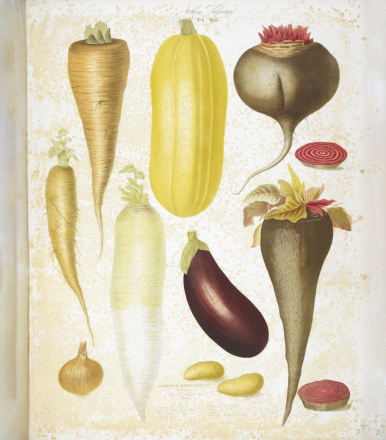
Among the rows, you find ancient carrots—not the bright orange of common varieties, but purple or white. Horn-shaped tomatoes grow beside poet’s carnations. Basil smells of the South, even in the Médoc. This is not a postcard garden, but an instrument of subtle signals. Each plant tells what the vine does not say at first. If the celery struggles, so does the soil.
Simon Nadeau, Lafite’s gardener, works with the team to tend to five hectares of fruit, flowers and vegetables on a daily basis.
On the edges, wild herbs hide old remedies: nettles, comfrey, yarrow. Dried and infused, they are sprayed as teas on the vines. A homemade cure when sap rises too fast or lingers too long. Nearby, fruit trees—greenhouse figs, Ente plums, dreamy quinces, unpredictable pears. The fig yields twice, the cherry tires before the vine, the quince bristles when insects arrive. Fruit is a weather log.
Even roses have their say when the skies shift. Spots, mildew, textures: their silence alerts before sensors do. Powdery mildew has no patience for their honesty. Nor do the gardeners.
Special care is given to the many species of flowers that brighten the garden below the Château.
Since 2021, Simon Nadeau has carefully orchestrated this living composition, a garden designed like a musical score, where each plant has its place and purpose. A landscape engineer, he coordinates a team of seven, two dedicated entirely to fruit trees and nourishing plants. Some species are planted as tests. Others remain under observation. The garden feeds a seasonal notebook that winemakers consult as often as their plots.
At Lafite, the orchard and vegetable gardens are not peripheral, they extend the reading of a vintage, provide diagnostic tools and strengthen the domain’s agronomic resilience. And sometimes, in the wake of an observation or the turn of a row, a fruit slips into an apron pocket. Just in time for a snack.
Read also
Roots Manoeuvre
Roots around roots
A herbarium (and arboretum) of our vine’s most important subterranean neighbours.