Cellar or shrine? Lafite’s secret beneath the vines
Underground cellar or neoclassical temple? Step inside Lafite’s most fantastical structure, designed by the visionary Catalan architect Ricardo Bofill.
Visually arresting. Faintly mystical. You might be forgiven for mistaking the underground cellar at Château Lafite Rothschild for a shrine.
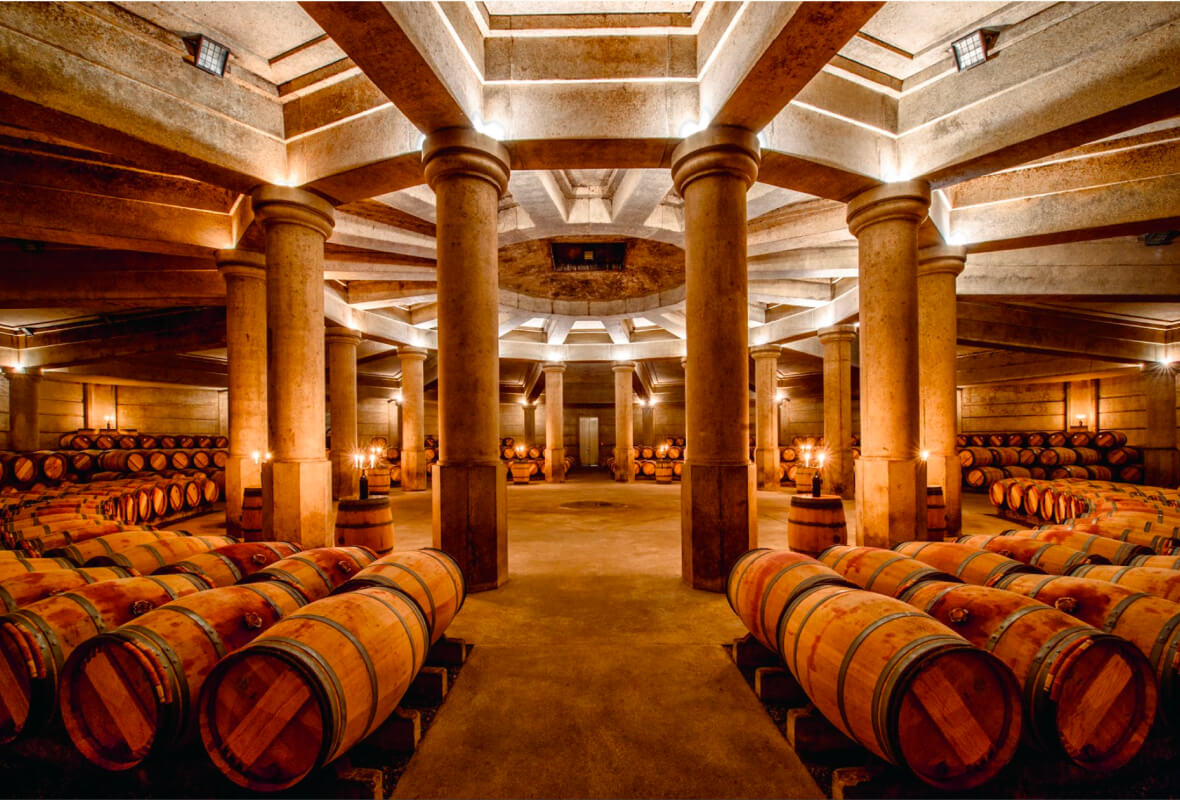
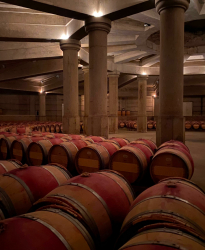
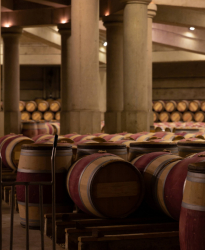
Two concentric circles of sixteen Ionic columns rise up from the earth, their surfaces smooth and pale, holding up the circular structure. The ceiling is composed of broad beams that radiate outward like sun rays from a central opening that mimics the sun. The light is low and atmospheric, emanating from small lamps perched on barrels and fixtures along the walls. The central space is clean and open, surrounded on all sides by an audience of purple-bellied barrels. Everywhere you look, the shapes repeat: the deep colours and rounded bodies of oak, the upright discipline of the columns, the angled beams above converging toward the centre. The scene evokes balance and symmetry. It’s visually arresting and faintly mystical. You might be forgiven for mistaking this space for a shrine. Even if you’re unaware of its origins, there is an air of belief here. You get the sense that this is a place shaped by intent, and a conviction that beauty can guide function.
The underground cellar at Château Lafite Rothschild, designed by the Catalan architect Ricardo Bofill.
Step inside the underground cellar at Château Lafite Rothschild, built in 1987 beneath the vineyards of Pauillac. Why does it look like a neoclassical temple? What was the inspiration behind its fantastical design? Its creation, much like many grand designs, began with a conundrum.
The aesthete and the architect
During the mid-eighties, Baron Eric de Rothschild was rethinking the classic storage system for barrels. There were too many of them, held in traditional ‘tunnel’ arrangements that were proving impractical. A fresh solution was needed, perhaps long alignments better suited to bottle-ageing.
The central rotunda of the underground cellar.
Baron Eric had long cultivated a taste for beauty. ’An aesthete of the highest order,’ as one French columnist wrote. And he had always admired the theatrical, even ornate visions of architect Ricardo Bofill. Bofill was described as an ‘adventurer of architecture,’ a Catalan dreamer who could leap from neoclassicism to Gaudí-like exuberance without losing his bearings. A visionary with a penchant for the elegant and the extravagant.
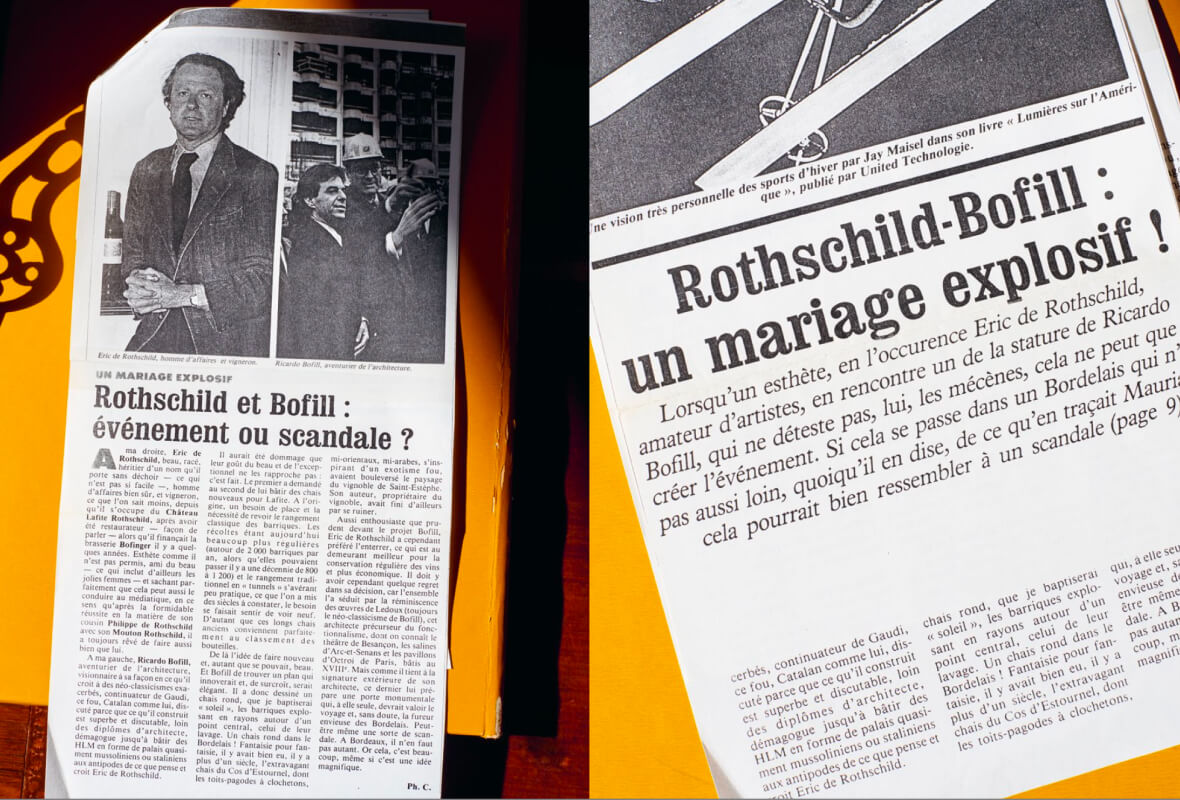
‘An explosive marriage!’ How the press covered Baron Eric and Bofill’s collaboration.
Divine but discreet
And so the Baron commissioned Bofill to design a new cellar. His brief to the architect was ‘to unite technical perfection with beauty’. Bofill came back with a plan that was, in the words of that same reporter, ‘unexpected, ample and elegant.’ A blueprint seemingly inspired by the circles of Ledoux, by the utopian clarity of 18th century saltworks and toll pavilions. A cellar buried under two metres of cultivated soil, invisible from the vineyard above, yet inside arranged like a radiant sun: barrels exploding outward around a luminous centre.
Baron Eric was delighted and nervous. In a speech following the cellar’s inauguration, he said, ‘Designing and organising a cellar of this kind has been one of the most enjoyable projects of recent years for me.’ He went on to explain the reasoning behind its design. Why is the cellar round? The Baron explained. ‘Because it allows the most efficient access to every barrel from the central point beneath the emblem of Lafite, minimising distance and labour.’ The structure was buried underground, he noted, ‘to ensure perfect temperature control’. And crucially, a central opening was introduced to allow natural daylight into the space, ‘so winemakers can work in real light rather than artificial gloom’.
Only once these technical decisions were fixed did architecture take centre stage. Looking back, Baron Eric summed up the result simply: ‘This blend of technique, craftsmanship, beauty, and architectural art created a place with, I believe, a certain charm.’
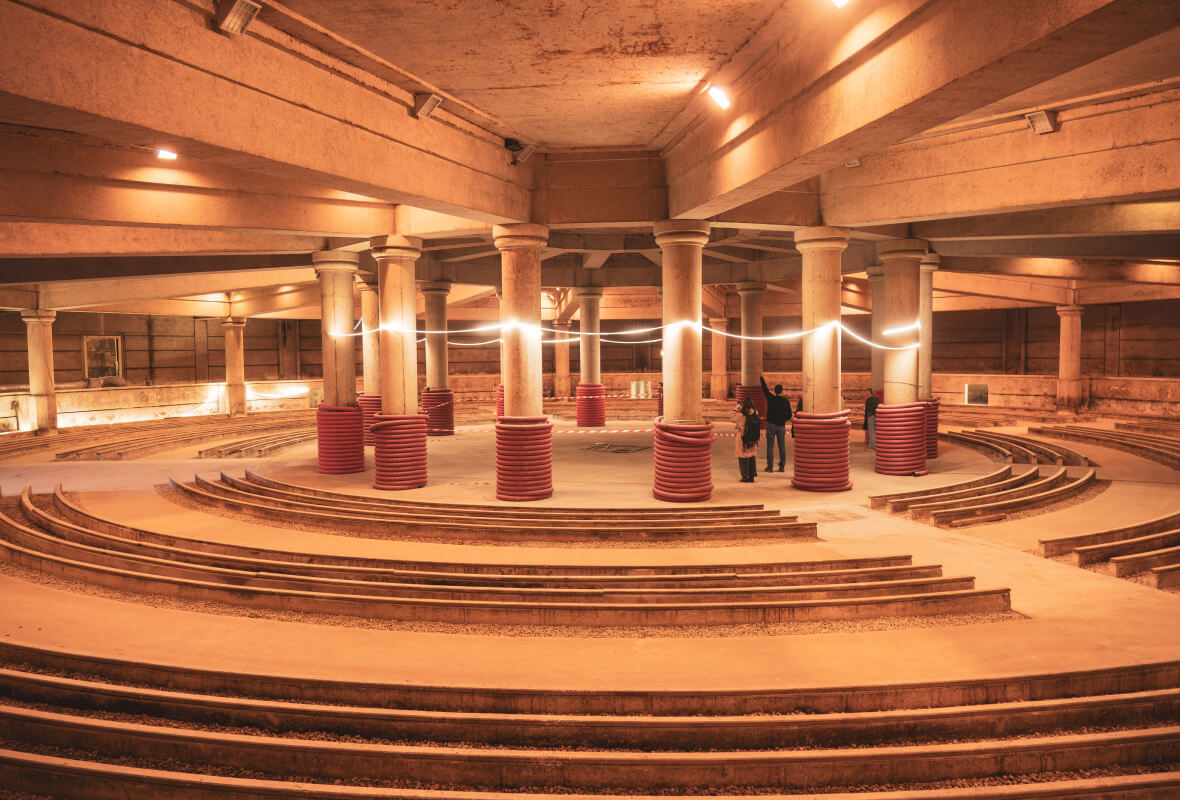
Concrete columns and beams detail the neoclassical structure of the underground cellar.
In Bordeaux, architectural flamboyance was often met with raised eyebrows. The last truly extravagant gesture had been the pagoda-like roofs of Cos d’Estournel—half-Oriental, half-Arabic, wildly exotic. But Baron Eric chose a different path. He decided to bury Bofill’s work underground, both literally and symbolically. The cellar would be magnificent, yes, but discreet.
Underground to all around
The cellar, inaugurated in 1987, was a novelty in Bordeaux. Until that point, wineries were utilitarian places, built for function rather than feeling. Lafite’s new underground structure—4,000 square metres of poured concrete, arranged with monastic geometry—was an event bordering on scandal, depending on who you asked.
But the cellar worked. It was cool, stable, efficient. The sloping ceiling made movement easy. The layout allowed staff to work undisturbed while visitors circled discreetly on raised galleries. And perhaps more importantly, it transformed expectations. It was proof that a cellar could be captivating and contemplative.
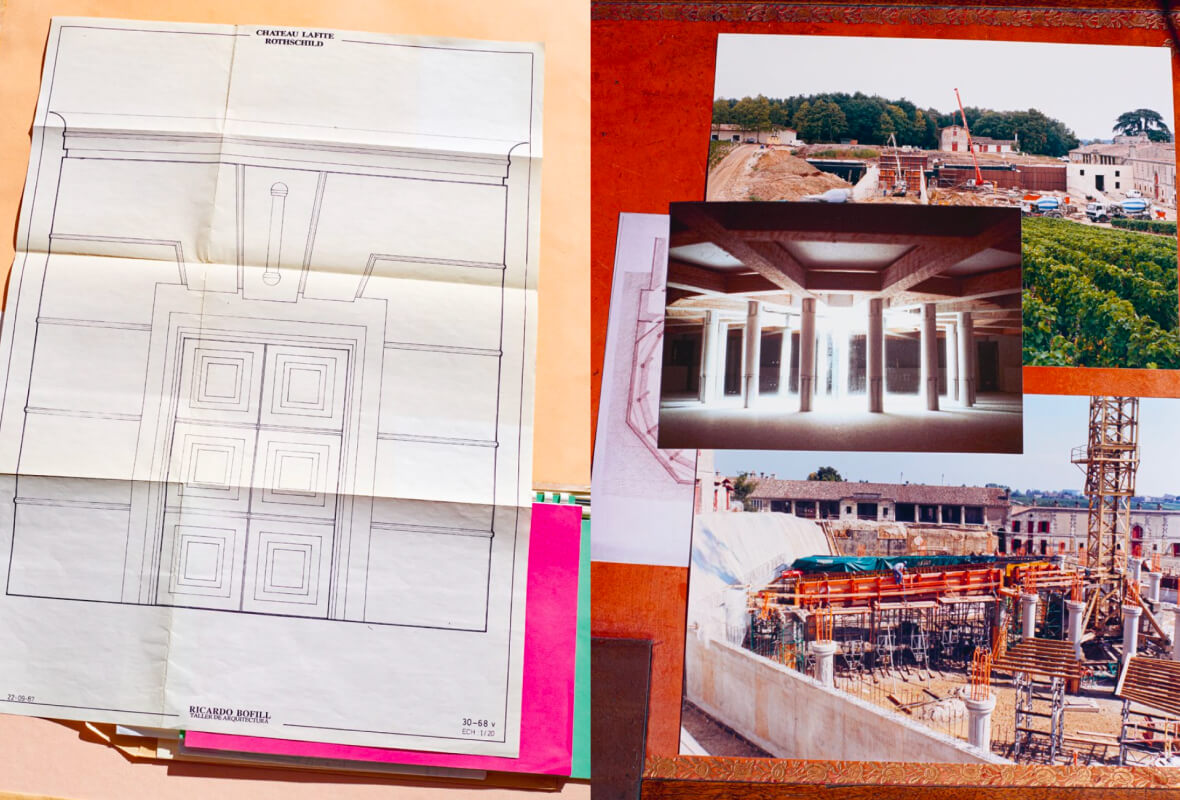
Architectural drawings and construction photographs documenting the design and building of the underground cellar.
Slowly, the region followed. Architects arrived: Nouvel, Starck, Portzamparc, Herzog and de Meuron. Cellars became cathedrals; wineries became museums; the Médoc, once stern and conservative, began to flirt with spectacle. You might say Baron Eric and Bofill had set this in motion. They had proved that architecture could sit beneath a vineyard without disturbing it—and that a winery could be both useful and transcendent.
Beyond Bofill
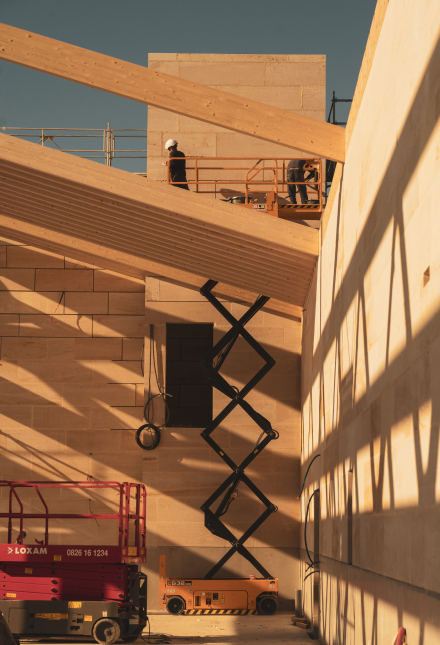
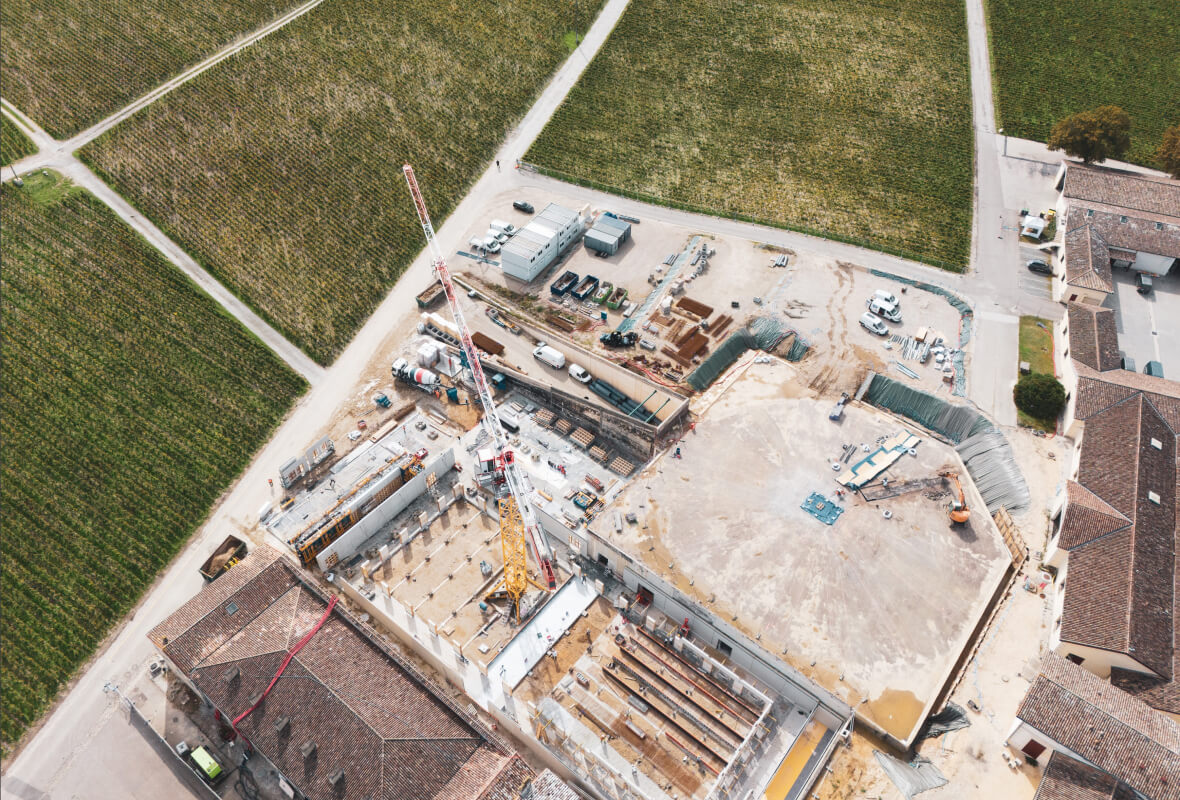
Today, Lafite is building again. A new gravity-fed winery is rising. Not underground, but above. The project represents an entirely new philosophy of organisation and sustainability. Where Bofill’s cellar concealed its grandeur, this new one may reveal a different relationship between vines and architecture: lighter, more open, more contemporary.
Rather than asserting itself as an object, the new cellar has been conceived as a choreography of movement, gravity and quiet precision. Grapes descend naturally. Wine circulates with minimal interruption. Distances are reduced. The architecture does not dominate the vineyard; it works with it. In the language of the architects involved, this is a form of ‘negative architecture’: a structure that defines itself less by what it shows than by what it carefully avoids disturbing.
The logic of discreetness persists even today. The new cellar is not an attempt to eclipse Bofill’s ‘sun’, but to orbit around it. Meanwhile, the underground cellar continues to age vintages that will shape the century. It hosts concerts, tastings and small rituals of wine culture. It remains, even now, a kind of secular chapel under the vines.
An aerial view of the construction of the new above-ground cellar.
Perhaps this is the paradox of Lafite: that its most audacious gesture is the one no one can see. And that, buried beneath the land that has defined it for centuries, lies a cellar that enables its residents to age gracefully, yet somehow stands outside time itself. A temple of ageing, built by two great believers, enduring faithfully in the dark.
Read also
At the roots of Château Lafite Rothschild
A FICTION OF THE FIRST DAY OF BARON JAMES DE ROTHSCHILD IN PAUILLAC
On September 7, 1868, Le Constitutionnel wrote: “Baron James de Rothschild has left Paris for Château Laffitte, Médoc, which he has just acquired.” After that? We asked the novelist and poet Bernard Chambaz to slip into the shoes – and mind – of the Baron.
A look inside the guestbooks of Château Lafite Rothschild and Viña Los Vascos.
From Pauillac to Chile, the guestbooks of Château Lafite Rothschild and Viña Los Vascos trace seventy years of shared memories, warm smiles, and whimsical sketches.
Unity – and fierce competition – between the Domaines
The French teams at Domaines Barons de Rothschild Lafite embody the family spirit – in blood, sweat and tears. We’ve brought you some snippets, from an extraordinary day at Lafite.