Even today, it’s hard to fully grasp the shockwave created by Drops of God. Published between 2008 and 2016 and now adapted into a Apple TV series, this wine-focused manga has reshaped how wine is perceived and talked about across the world. By treating bottles like characters and weaving together tasting, emotion and popular culture, it has expanded wine appreciation far beyond its usual boundaries.
In the world of wine, it once felt like everything had been seen before: Parker scores, Hong Kong auctions…and then a Japanese manga came along and changed the rules. At first glance, manga and fine wine seem worlds apart, each governed by its own codes, rituals and cultural distance. And yet the authors, writing under the name Tadashi Agi, succeeded in combining the artistry of manga with the rigour of sommellerie to turn what was once considered an elite culture into a global phenomenon.
It begins with a familiar, almost routine gesture: opening a bottle, inhaling its aromas, letting them unfold. This is exactly what Shizuku Kanzaki, the manga’s protagonist, experiences. Through him, the reader discovers a Burgundy or a Châteauneuf-du-Pape as they would a character in a story. For millions of readers, this was also their first introduction to wine.
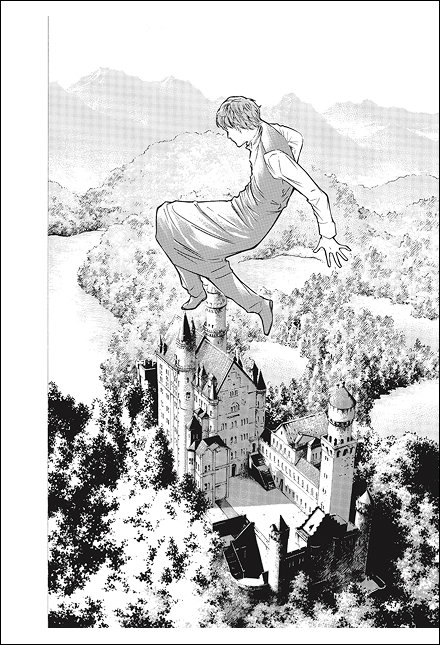
This young sommelier appears to be floating above a château somewhere in Bavaria, but that’s precisely the effect a 1990 Château Lafite Rothschild has on him.
Imagine a young reader in Korea, China or Taiwan on a Saturday afternoon, the manga resting on their lap. They turn the pages, drawn into the story, and suddenly a name appears: Château Mont-Pérat. They’ve never seen it on a shelf, don’t quite know where it comes from, but in their mind, it becomes something extraordinary. A treasure. A mythical bottle. A wine they simply must taste one day.
Tenchijin: the mystical idea behind the manga
The authors never set out to sanctify wine. ‘We simply wanted to spark curiosity and encourage more people to explore this world.’ Yet by describing wine as a living being—with a past, moods, almost a soul—they tapped into something deeply universal. The result is almost magical: readers find themselves dreaming, wanting to taste, to share and to talk about wines they might never otherwise have encountered.
In the manga, wine is never reduced to technical notes like ‘red fruit, good length, silky tannins’. Instead, it becomes a rain-soaked street in a Jacques Demy film, a melody by Johannes Brahms, a childhood memory.
According to Tadashi Agi, this is where the myth begins: when we realise that every bottle carries a story, that of a winemaker, a terroir, a vintage. At the heart of this idea lies tenchijin: heaven, earth and humankind.
‘Heaven’ is the vintage, the growing season that may bring perfect weather or unexpected challenges, generous sunshine or untimely rain. ‘Earth’ is the terroir: the soil, the climate, everything that gives the grape its identity, aroma and structure. And ‘humankind’ is the winemaker, the one who works the vines, understands the land and decides when to harvest, how to vinify and how to age the wine.
As the creators explain, ‘when these three elements come together in the best possible way, they give rise to a wine that truly moves people. The myth that forms around it is a natural extension of that alchemy. There is, of course, the “mystery of terroir”, but ultimately it is people who bring that terroir to life, or allow it to fade.’
Rather than relying on the technical language of sommeliers, the authors interpret wine through images and sensations that resonate with everyone. ‘That’s why readers have been able to connect so deeply with our manga.’
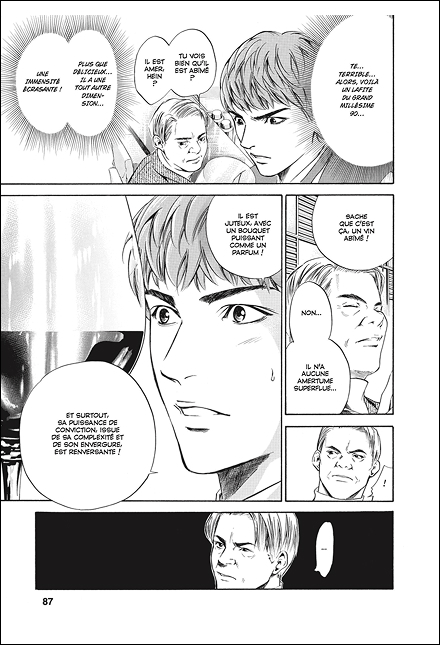
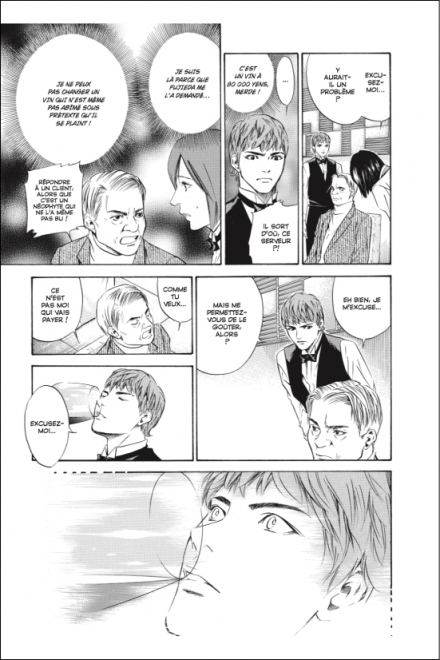
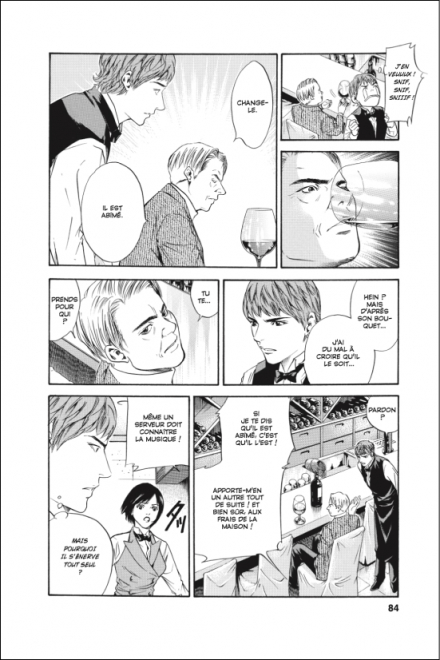
The confrontation between a wounded enthusiast, heart and stomach alike, and a young sommelier bold enough to challenge him.
Wine is woven into the lives of the characters. It reflects their moods, and sometimes suffers because of them. In Volume 15, a knowledgeable enthusiast sends back a 1990 Château Lafite Rothschild, declaring it corked. The sommelier tastes it and is struck by ‘a bouquet as powerful as a perfume’. The exchange escalates into confrontation until the owner of the wine bar intervenes: he realises the customer is suffering from an ulcer. The man admits to stomach pain, his palate dulled by bitterness following a recent divorce, preventing him from appreciating the exceptional vintage he ordered.
‘Our manga has become a shared language’
This distinctive storytelling lies at the heart of Drops of God’s success. The manga has resonated with younger generations across Asia and far beyond. Readers have learned to understand wine through an emotional narrative, sometimes, in Tadashi Agi’s words, approaching ‘a form of synaesthesia that transcends borders and cultures’.
Since the series became a bestseller, the authors have connected with readers around the world. What surprised them most was how widely this way of experiencing wine, through images and sensations, had spread.
The fascination has had tangible effects on the market. Château Mont-Pérat, once relatively unknown, saw its sales surge and its price increase tenfold. But the manga’s impact goes beyond commerce: it has created a shared culture. In Japan, wine gatherings among friends have multiplied. ‘Our manga sometimes acts as a common language. It has led to price increases for certain wines, but that was neither planned nor intended,’ the authors explain.
They also emphasise a principle close to their hearts: price and rarity should not be the primary criteria by which a wine is judged.
Their aim is to help everyone, young and old alike, discover the simple, accessible pleasure of wine, free from hierarchy or exclusivity. In other words, it is as much about democratising wine as it is about bringing it to life in the minds of those who drink it.
Read also
Grands crus and the Big Screen
What do François Pignon and James Bond have in common? Lafite, of course!
A look inside the guestbooks of Château Lafite Rothschild and Viña Los Vascos.
From Pauillac to Chile, the guestbooks of Château Lafite Rothschild and Viña Los Vascos trace seventy years of shared memories, warm smiles, and whimsical sketches.